

Side Effect Reduction Calculator
Your Current Treatment
Combination Therapy Benefits
Potential Benefit: +25-35% less side effects
Based on medical evidence for high blood pressure treatment
For years, doctors reached for one drug at a high dose to control high blood pressure, diabetes, or even cancer. But that approach often came with a heavy price: dizziness, nausea, swelling, or worse. Now, a smarter strategy is taking over - using combination therapy, where two or more medications are given at lower doses together. It’s not about adding more pills. It’s about working smarter.
Why Lower Doses Work Better Than One High Dose
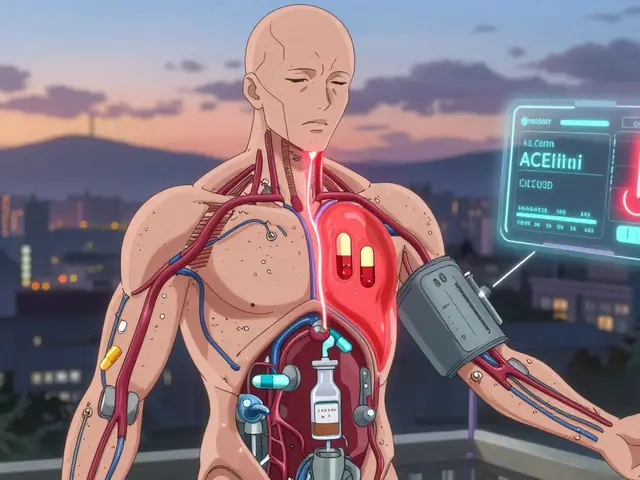
Think of your body like a machine. When you push one part too hard, it breaks down. That’s what happens with high-dose monotherapy. A 2002 study by Dr. Norman M. Kaplan found that using the full dose of a single blood pressure drug caused 37% more side effects than using half-doses of two different drugs together. The reason? Side effects are often tied to how much of one drug is in your system. Lower the dose, and you lower the risk. In hypertension, combining half-doses of an ACE inhibitor and a calcium channel blocker drops systolic blood pressure by 8.7 mmHg more than the highest single-drug dose. At the same time, swelling (edema) drops from 14.3% to 4.1%, and that annoying dry cough from 9.8% to just 2.3%. It’s not magic. It’s pharmacology. Different drugs hit different targets. Together, they cover more ground without overloading any one system. This isn’t just for blood pressure. In type 2 diabetes, combining metformin 1000 mg/day with an SGLT2 inhibitor like empagliflozin 10 mg/day gives the same HbA1c drop as doubling metformin - but cuts gastrointestinal side effects from 26.4% to 11.7%. That’s a huge win for patients who quit meds because they couldn’t stomach the pills.Real-World Results: Faster Control, Fewer Complications
A 2023 JAMA study tracked over 15,000 patients with high blood pressure. Those who started on a two-drug combo reached their target BP in 63 days. Those on single drugs took 117 days. That’s nearly two months faster. And those extra months? They cost lives. The combo group had 34% fewer heart attacks, strokes, and hospitalizations. In cancer, the numbers are just as striking. A combination of anthracycline and cyclophosphamide at reduced doses works just as well as a high-dose anthracycline alone - but cuts severe neutropenia (dangerously low white blood cells) from 38.7% to 19.2%. Heart damage? Drops from 7.3% to 2.1% over five years. That’s not just about survival. It’s about quality of life. Even more compelling? The UMPIRE trial, published in The Lancet, gave 12,200 people without heart disease a single pill with four drugs at half-doses: aspirin, simvastatin, lisinopril, and atenolol. Five years later, they had 53% fewer heart attacks, 51% fewer strokes, and 49% lower death rates from heart disease. All from pills that were half the usual strength. No one needed to take full doses of anything.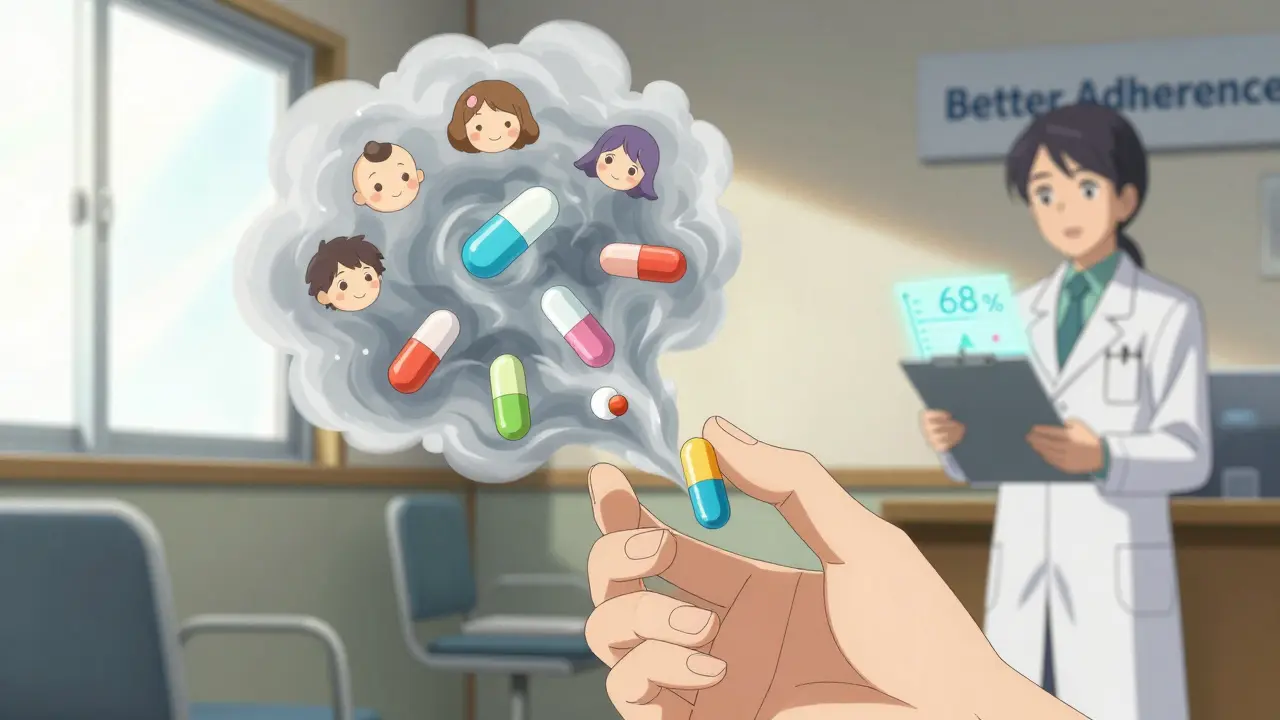
The Pill Burden Problem: When More Pills Backfire
Here’s the catch: taking multiple pills is hard. People forget. They get overwhelmed. A 2024 Diabetes Care survey found 31% of patients on combination therapy stopped within a year - not because it didn’t work, but because they felt buried under pills. Reddit threads from r/Diabetes in early 2024 showed 62% of 1,450 commenters saying they were frustrated with “too many medications.” One wrote: “I take 8 pills a day. I can’t tell if I’m alive because of them or dying from them.” That’s why fixed-dose combinations (FDCs) are changing the game. A single pill with two, three, or even four drugs in one tablet cuts pill burden dramatically. The American Heart Association found 68% adherence for single-pill combos versus 52% for separate pills. Patients say things like, “I only have to remember one thing in the morning.” But FDCs aren’t perfect. They limit flexibility. If you need to adjust one drug’s dose, you can’t - because it’s locked in. That’s why some doctors still prescribe loose combinations, especially early on. But for stable patients? FDCs win.Who Benefits Most - and Who Should Be Careful
Combination therapy shines in moderate to high-risk patients. The European Society of Cardiology recommends it as first-line for stage 2 hypertension. The American Diabetes Association says to start combination therapy within 3-6 months if HbA1c is above 7.5%. Why? Because monotherapy fails in 59% of patients within three years. But not everyone. A 2022 NEJM study found triple-combination therapy raised the risk of acute kidney injury by 1.8 times in older adults with low kidney function (eGFR under 45). For them, less is more. Sometimes, one well-chosen drug at a moderate dose is safer than two. Drug interactions are another hidden danger. The FDA’s adverse event reports from 2023 showed 2,317 complications tied to combination therapy - 48% of them involved older adults on five or more medications. A common mix? Blood thinners, statins, and blood pressure drugs. That’s why pharmacist-led medication reviews are now recommended. One 2023 study showed these reviews cut adverse events by 28%.
Costs, Access, and the Future
Yes, combination therapy can cost more upfront. A 2024 IQVIA report says the average annual cost is $4,217 versus $2,864 for a single drug. But here’s the flip side: in diabetes, those extra costs are offset by $7,842 less spent on complications like kidney failure, amputations, and hospitalizations. Insurance coverage varies. In the U.S., 37% of uninsured patients walk away from combo prescriptions at the pharmacy. That’s why generic FDCs are exploding. The FDA approved 47 new combination drugs in 2023 - up from 32 in 2022. India’s “polypill” program, which combines four heart drugs in one pill, jumped from 5.3% to 18.7% of prescriptions between 2020 and 2023. The future? We’re moving toward “response-adaptive” therapy. Instead of starting with two drugs, you start with one, monitor how the body responds, then add the next only if needed. A 2024 Harvard study suggests this could cut unnecessary drug exposure by 40% without losing effectiveness. The POLYDELPHI trial, currently enrolling 15,000 people, is testing a five-drug combo at ultra-low doses - each at just 20-30% of normal. If it works, we could prevent heart disease with a pill that barely registers on the scale.What You Need to Know
If you’re on multiple meds or starting treatment for a chronic condition:- Ask if a lower-dose combo could work for you - especially if you’re struggling with side effects.
- Request a fixed-dose combination if you’re taking two or more pills daily.
- Get a medication review from a pharmacist if you take five or more drugs.
- Don’t assume more pills = better results. Sometimes, less is more.
- Track your symptoms. If you feel worse after a combo change, tell your doctor. It might not be the drugs - it might be the mix.
Combination therapy isn’t about throwing everything at the wall. It’s about precision. It’s about balance. And for millions of people, it’s the difference between managing a disease - and living with it.
Is combination therapy safe for older adults?
It can be, but it requires careful monitoring. Older adults, especially those over 75 with reduced kidney function (eGFR under 45), are at higher risk for acute kidney injury with triple-combination therapy. Single-pill combinations with two drugs at low doses are generally safer than multiple separate pills. Always ask for a pharmacist-led medication review if you’re on five or more drugs.
Do combination pills have more side effects than single drugs?
No - they usually have fewer. Side effects often come from high doses of one drug. By lowering each drug’s dose and combining complementary mechanisms, you reduce the chance of dose-related side effects. For example, combining half-doses of an ACE inhibitor and a calcium channel blocker cuts swelling and cough by more than half compared to full-dose ACE inhibitor alone.
Are fixed-dose combinations (FDCs) better than taking separate pills?
For adherence, yes. A 2023 American Heart Association survey found 68% of patients took their single-pill combo regularly, compared to only 52% who took multiple pills. Easier to remember, fewer pills to manage, and fewer chances to miss a dose. But FDCs limit dose flexibility. If your doctor needs to adjust one drug, a loose combination might be better - at least at first.
Why do some doctors still use single-drug therapy first?
Tradition, cost, and caution. Some providers worry about masking side effects or over-treating. Others follow older guidelines. But current standards from the American Diabetes Association, European Society of Cardiology, and others now recommend combination therapy as first-line for moderate-to-high-risk patients. If your doctor hasn’t mentioned it, ask why.
Can combination therapy help me avoid hospital visits?
Yes - and that’s one of its biggest strengths. A 2023 study found patients on initial combination therapy for high blood pressure had 34% fewer cardiovascular events and 22% lower healthcare use. In diabetes, fewer complications mean fewer ER trips for ketoacidosis or foot ulcers. The goal isn’t just to lower numbers - it’s to keep you out of the hospital.
How do I know if combination therapy is right for me?
Ask yourself: Are you struggling with side effects from one drug? Is your condition not improving? Are you taking three or more pills daily? If yes, combination therapy may help. Talk to your doctor or pharmacist. Bring your current meds list. Ask: ‘Would a lower-dose combo be safer or more effective for me?’

Combination therapy is a game-changer, honestly. I used to be on three separate meds for my BP and felt like a walking pharmacy. Switched to a single-pill combo last year, and suddenly I’m actually remembering to take them. No more panic at 7 a.m. wondering which pill I already took. Also, the edema? Gone. The dry cough? Vanished. It’s not magic-it’s just smart science.
Also, shoutout to pharmacists. They’re the real MVPs. My pharmacist caught a dangerous interaction between my statin and grapefruit juice. I would’ve never known. Please, if you’re on five+ meds, go see one. Seriously.
And yes, FDCs aren’t perfect, but for 80% of people? They’re the answer.
This is exactly why I started advocating for my mom’s care after she nearly quit her meds because of nausea. She was on full-dose metformin and it felt like her stomach was trying to escape. Switched to metformin + empagliflozin at half doses-suddenly she could eat breakfast without dread. She’s been stable for two years now. It’s not about the number of pills. It’s about the number of days you feel human.
Also, the part about the UMPIRE trial? That’s the future. One pill. Four drugs. Half doses. We’re basically turning medicine into a minimalist lifestyle.
OMG this is why India is leading the world in polypill innovation! We’ve been doing this since 2018 with our heart combo pills-lisinopril, atorvastatin, aspirin, and metoprolol all in one tablet for just 15 rupees a day! Americans still think ‘more pills = better’? Nooo, we’re saving lives with simplicity!
And guess what? Our rural clinics have 72% adherence. Why? Because people don’t have to carry 5 different bottles. They just take ONE. I wish the FDA would just copy us. We don’t need 12 different brands. One smart pill is enough. Also, my cousin’s BP dropped from 168 to 122 in 3 weeks. No side effects. Just pure Indian science.
Stop overcomplicating. We’ve been doing this right for years. Why are you still debating? The data is here. Look at our numbers. We’re not just talking-we’re saving lives with a single tablet. #PolypillRevolution
I’m not saying this isn’t good science, but… have you seen the cost? $4,217 a year? That’s more than my rent. And don’t even get me started on insurance denials. I’ve been denied three times for my combo pill. They say ‘it’s not first-line.’ But my doctor says it is. So who’s right? The algorithm or the person who actually treats me?
Also, why is it always ‘patients should ask their doctor’? What if your doctor doesn’t know? What if they’re still stuck in 2010? I’ve had three different docs tell me ‘one drug at a time’ like it’s gospel. It’s exhausting. I’m tired of being the one who has to educate my own care team.
So let me get this straight-instead of fixing the root cause, we’re just slapping together 4 weak drugs and calling it a day? That’s not medicine. That’s band-aid chemistry.
And don’t even get me started on the UMPIRE trial. Four drugs at half doses? That’s not precision-it’s diluted chaos. What if one of them doesn’t even work? You’re just masking failure with more pills. I’ve seen patients get worse on combos because the interactions were never tracked. This feels like corporate medicine pushing pills, not healing.
And don’t tell me about adherence. Adherence doesn’t fix bad science.
Thank you for this meticulously researched and profoundly thoughtful exposition. The evidence presented-particularly from the UMPIRE trial and the JAMA cohort study-is not only statistically significant but clinically transformative.
It is imperative that clinical practice evolve in alignment with these findings, as the reduction in cardiovascular morbidity and mortality is not merely a statistical advantage, but a human one. The emphasis on fixed-dose combinations as a vehicle for improved adherence, while acknowledging the necessity of individualized titration in early phases, demonstrates a nuanced understanding of therapeutic balance.
One might argue that the future lies not in escalation, but in elegant simplification.
YOU THINK THIS IS GOOD? LET ME TELL YOU ABOUT MY UNCLE.
He was on a combo pill-three drugs in one. Got sick. Went to the ER. Turned out one of the drugs was causing his potassium to crash. They didn’t catch it for THREE WEEKS because they thought ‘oh, it’s just a combo pill, it’s safe.’
He ended up in the ICU. His kidneys never recovered.
So don’t give me this ‘it’s science’ BS. Science doesn’t care if you’re alive. It just wants to be published.
And now he’s on FIVE drugs to fix the damage from the FIVE drugs he was on before. This isn’t progress. It’s a pyramid scheme with prescriptions.
I’ve been on combination therapy for 7 years now-type 2, hypertension, and high cholesterol. I started with three separate pills. Then switched to a two-drug combo, then a three-drug FDC. Now I take one pill a day. My HbA1c is 5.8. BP is 118/76. Cholesterol? Under 150.
But here’s the thing nobody talks about: the mental load. Before the combo, I had a Google calendar with alarms for every pill. Now? I just take my one pill after coffee. It’s not about the chemistry-it’s about the peace of mind.
And yeah, I’ve had my moments. One time I missed a dose and felt weird for a day. But I didn’t panic. I just took the next one. No guilt. No shame.
Also, my pharmacist gave me a little card that says ‘I take ONE pill. Ask me how.’ I carry it in my wallet. People ask. I tell them. It’s become my thing.
Wait-so if you combine half-doses of drugs that work on different pathways, you get better results AND fewer side effects? That’s wild. I always thought more drugs = more risk. But nope. It’s like using a Swiss Army knife instead of a sledgehammer.
And the part about FDCs improving adherence? HUGE. I used to be the guy who’d forget his meds because I had 7 different bottles. Now I take one. One. That’s it. I even got a pill box with the FDC labeled ‘The One.’
Also, the UMPIRE trial? That’s the future. Imagine a pill with 5 ultra-low-dose drugs. Like a health smoothie in tablet form. We’re not just treating disease-we’re preventing it before it even starts. Mind blown.
Just wanted to say-this is why I started volunteering at my local pharmacy. I help elderly patients sort their meds. So many of them are on 6-8 pills. Some of them can’t read. Some have tremors. One woman told me, ‘I don’t know if I took my blue pill or my green one.’
When we switched her to a two-drug FDC? She cried. Not from sadness-from relief. ‘I can finally sleep again,’ she said.
It’s not about the science. It’s about dignity. Taking one pill instead of six isn’t just convenient. It’s empowering.
And yeah, I know FDCs aren’t perfect. But they’re the best thing we’ve got right now. Let’s not throw them out because they’re not perfect. Let’s fix the gaps-like making them cheaper, more flexible.
Also, pharmacists? We’re not just pill dispensers. We’re lifelines.
My grandma took 8 pills a day. She was 82. She’d forget. She’d double up. She’d get dizzy. We almost lost her last year from a drug interaction.
Then her pharmacist suggested a combo pill. Two drugs in one. She’s been on it for 10 months. No more confusion. No more hospital visits. She’s gardening again.
I didn’t know this stuff was possible. I thought ‘more pills = better care.’ Turns out, it’s the opposite. Less clutter. More life.
Thank you for writing this. My grandma’s story isn’t unique. It’s common. And it’s fixable.
Yeah, but what about the long-term data? Like, 20 years out? We don’t know. We’re just throwing things together and hoping it works. This feels like a trend, not a breakthrough. Also, why are we so obsessed with pills? What about diet? Exercise? Sleep? Oh right-we don’t talk about those because they don’t make money.
Thank you for articulating with such clarity the paradigm shift occurring in chronic disease management. The data are unequivocal: precision dosing through synergistic pharmacological combinations yields superior outcomes with markedly reduced adverse events. The transition from monotherapy to fixed-dose combinations represents not merely an innovation in pharmaceutical delivery, but a redefinition of patient-centered care. The emphasis on adherence, dignity, and prevention is profoundly aligned with the ethical foundations of medicine. One can only hope that policy and reimbursement structures evolve with equal speed.