
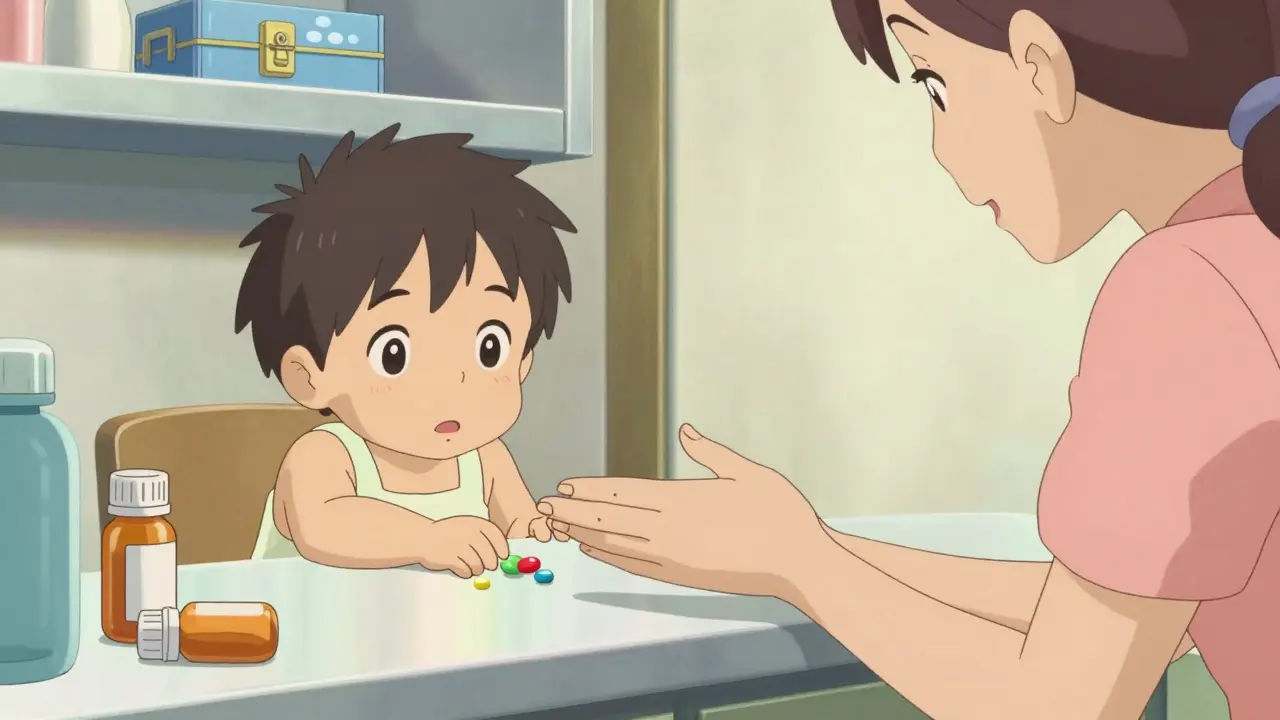
Every year, 50,000 children under age five end up in emergency rooms because they accidentally swallowed medicine they found at home. Some of these pills - like opioids, heart meds, or even prenatal vitamins - can kill a small child with just one or two doses. And it’s not just at home. Schools, grandparents’ houses, and babysitters’ bags are also common places where kids find dangerous pills. The good news? Teaching kids how to handle medicine safely doesn’t have to be complicated. With the right approach, even a 3-year-old can learn to say, "I don’t touch that," and an 8-year-old can check a label before taking anything.
Why Kids Are at Risk
Kids aren’t being naughty when they grab a pill. They’re curious. Medicine often looks like candy - colorful, sweet-tasting, and sometimes shaped like animals or stars. A 2021 FDA study found that 78% of toddlers aged 2 to 3 copied an adult taking medicine within a minute of watching them. That’s not imitation; it’s instinct. And when parents say, "This is for your cough," without explaining why it’s not food, kids don’t understand the difference. The real danger isn’t just what’s inside the bottle. It’s where the bottle is kept. The CDC reports that 67% of accidental poisonings in kids aged 1 to 4 could be prevented with proper storage. Yet, nearly 20% of parents still keep medicine on nightstands, kitchen counters, or in purses. Grandparents? 63% keep pills in suitcases or handbags when kids visit. That’s not negligence - it’s lack of awareness.What Kids Should Learn at Each Age
Teaching medication safety isn’t a one-time talk. It’s a step-by-step process that changes as kids grow. Here’s what experts recommend based on developmental stages:- Ages 3-4: Teach them to give any found pill to a grown-up. No tasting. No sharing. Use simple phrases like, "Medicine is not candy. If you see it, tell me." Role-play with toy bottles and pretend pills. Make it a game: "Who can find the medicine and bring it to Mommy?"
- Ages 5-6: Kids can start recognizing medicine bottles. Let them help stick their name on the bottle. Explain that medicine is only for the person it’s named for. Teach them to say, "I feel weird," if they take something and don’t feel right. Practice reading labels together - "This says ‘for Emma’ - so it’s not for you."
- Ages 7-8: They can learn to use an oral syringe (not a spoon!) and track when to take medicine. Show them how to check the label against what the doctor said. At school, they should know never to take medicine from another child or a teacher without a parent’s note. Kids this age should also know their own weight - it matters for dosing.
By age 8, kids should understand that medicine is a tool - like a key or a hammer. It helps when used the right way, but it can hurt if misused. This mindset shift is powerful. It turns fear into responsibility.
How Schools Are Helping
Not every school has a nurse. In fact, only 39% of U.S. schools have a full-time nurse. But that doesn’t mean safety stops at the classroom door. Programs like Generation Rx’s Medication Safety Patrol are making a difference. They use role-playing, posters, and short videos to teach kids how to spot medicine versus candy. One school in Columbus reported a 34% drop in medicine-related incidents after using the program for two years. Head Start programs, which serve low-income families, have strict rules. Staff must complete 8 hours of training and pass a test on things like proper labeling, consent forms, and recognizing allergic reactions. Every dose is logged. Every bottle is locked. It’s not optional - it’s required by federal law. But in rural areas, many teachers don’t have access to these materials. A 2023 survey found 76% of rural educators had no printed safety guides. That’s a gap. And it’s dangerous. Kids in those areas need help just as much.
What Parents Can Do Right Now
You don’t need a degree in pharmacology to keep your kids safe. Here’s what actually works:- Lock it up. Use a lock box that meets ASTM F2057-22 standards. Keep it up high - not on a shelf a toddler can reach. Child-resistant caps aren’t enough. A 2023 CDC study showed only 29% of parents who rely on those caps store medicine safely. With locked storage? 86%.
- Use the right tool. Never use a kitchen spoon. Use an oral syringe - they’re free at most pharmacies. Measuring with a spoon can lead to 98% dosing errors. That’s not a typo. It’s science.
- Say it clearly. Never call medicine "candy." Even jokingly. A 2019 study found this increases ingestion risk by 220%.
- Practice weekly. Spend 10 minutes a week playing "Medicine Detective." Hide a toy pill and ask, "What do we do if we find this?" Reward correct answers with praise, not candy.
- Save the number. Program 800-222-1222 (Poison Help) into every phone in your house. Ninety-one percent of poison calls happen within an hour. Speed matters.
The Big Gap Nobody Talks About
Most programs stop at age 10. But here’s the truth: kids start misusing prescription drugs around age 13. By 16, it’s the second-leading cause of unintentional injury death for teens. Yet, no one teaches them about sharing pills, taking more than prescribed, or mixing medicine with alcohol. That’s a problem. Experts like Dr. Stephen Wallace say we’re failing teens. We teach kids not to touch medicine - but we don’t teach older kids how to use it responsibly. That’s like teaching a kid not to touch a car, then handing them the keys at 16 without a driver’s ed class. The fix? Start early, but keep going. By age 12, kids should understand why some meds are controlled, how to read a prescription label, and what happens when you take someone else’s medicine. Schools need to add this to health classes. Parents need to keep the conversation open.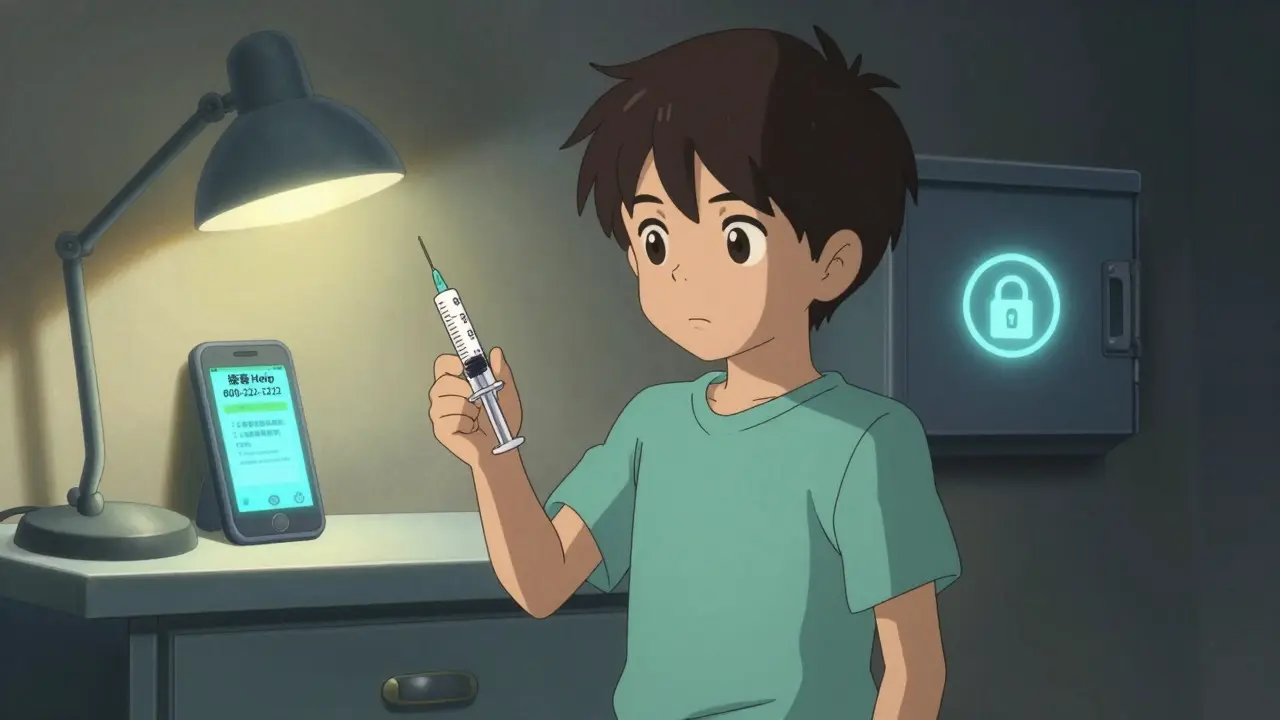
What’s Changing in 2025
The CDC is expanding its PROTECT Initiative to include teen-focused education in 2024. The American Academy of Pediatrics is updating its guidelines in early 2024 to include telehealth considerations - like how to store medicine when a child is home alone after a virtual doctor visit. And in 2025, the National Association of School Nurses will roll out the first standardized set of medication safety competencies for elementary students. One new trend? Brightly colored, flavored liquid medicines are causing more poisonings than ever. A 2023 study showed a 45% jump in exposures among kids under 5. The FDA is now talking with drug makers about adding bitterants - something that tastes awful - to these liquids. It’s not a perfect fix, but it’s a step.Final Thought: Safety Starts With You
You don’t need to be perfect. You just need to be consistent. Lock the medicine. Say it clearly. Practice often. Talk to teachers. Call the Poison Help line if you’re ever unsure. The goal isn’t to scare your child. It’s to give them power - the power to say no, to ask questions, and to protect themselves.Medicine isn’t magic. It’s not candy. It’s a tool. And like any tool, it’s safe when used the right way - and dangerous when it’s not. Your child doesn’t need to know every drug name. They just need to know this: "If I didn’t get it from you, I don’t take it."
At what age should I start teaching my child about medicine safety?
Start as early as age 3. Even toddlers can learn simple rules like "Don’t touch medicine unless a grown-up gives it to you" and "Tell me if you see pills." Use role-playing and everyday moments - like when you take your own medicine - to reinforce the message. The FDA and American Academy of Pediatrics agree: early, simple lessons build lifelong safety habits.
Is it safe to store medicine in a child-resistant bottle?
Child-resistant caps are helpful, but they’re not foolproof. A 2023 CDC study found that only 29% of parents who rely on these caps store medicine safely. Kids as young as 2 can open them with enough time and curiosity. The best practice is to lock medicine in a box that meets ASTM F2057-22 standards and keep it out of reach - even if the cap is child-resistant.
Can I use a kitchen spoon to give my child medicine?
No. Kitchen spoons vary in size and can lead to dosing errors of 40% to 98%. Always use an oral syringe - they’re free at most pharmacies and come with clear markings. Even if the label says "teaspoon," use the syringe that came with the medicine. It’s the only way to be accurate.
What should I do if my child swallows medicine by accident?
Call Poison Help immediately at 800-222-1222. Don’t wait for symptoms. Don’t try to make them vomit. Don’t give them milk or food unless instructed. Ninety-one percent of poison calls happen within an hour of ingestion, so speed is critical. Keep the medicine bottle handy - the poison control team will need to know what was taken and how much.
Why do some medicines look like candy?
Manufacturers make them colorful and sweet-tasting to help kids take them - especially for chronic conditions like asthma or epilepsy. But that design increases the risk of accidental ingestion. Experts now recommend using bitterants (unpleasant tastes) in these liquids to discourage kids from drinking them. In the meantime, always store them securely and never refer to them as candy.
How can I talk to my child’s school about medication safety?
Ask if they have a written medication policy. Check if staff are trained in proper storage, labeling, and administration. Request a copy of their medication log form. If they don’t have a program, share resources like Generation Rx’s free toolkit for schools. Most schools are willing to improve - especially when parents ask.
My 4-year-old saw my ibuprofen bottle and asked if it was gummy bears. I didn’t laugh. I locked it up that night. This post saved me from a nightmare. Thank you for the clear, practical steps. No fluff, just life-saving info.
in india we dont always have lockboxes or oral syringes but we do have old tupperware and a high shelf. my mom taught me never to touch anything in her purse since i was 3. she never said medicine was candy. she said its for sickness only. simple. no drama. it worked. now my niece does the same. its not about tech its about habit.
Let’s be real - this whole ‘medication safety’ narrative is a corporate-fed distraction. The real issue is pharmaceutical companies designing drugs to look like candy to hook kids early. You think it’s an accident? It’s marketing. They know toddlers are impressionable. They know parents are distracted. And they profit from both. Lockboxes won’t fix a system that monetizes pediatric vulnerability. The FDA should be banning flavored opioids, not handing out ‘Medicine Detective’ worksheets. This is a public health crisis engineered by profit, not negligence.
While the behavioral conditioning framework presented here is empirically sound - particularly the operant reinforcement of label recognition in ages 5–8 - the underlying epistemological flaw lies in its assumption of universal parental agency. In contexts of socioeconomic precarity, where polypharmacy is normalized and storage infrastructure is non-existent, the ‘lockbox’ heuristic becomes a classist fantasy. Moreover, the conflation of ‘tool’ with ‘responsibility’ in developmental psychology is problematic - children do not possess the metacognitive capacity to internalize abstract risk calculus before age 9. The model must be reconceptualized through a neurodevelopmental lens, not a behavioral checklist.
THEY WANT YOU TO THINK THIS IS ABOUT SAFETY... BUT WHAT IF THEY'RE PUTTING TRACKERS IN THE BOTTLES?? I heard from a nurse friend (who got fired for talking) that the new liquid meds have microchips under the flavor coating. They're tracking kids who touch medicine. Why? So Big Pharma can sell ads to your phone when your kid 'accidentally' takes something. Also, why is the Poison Help number the same as the CDC hotline? COINCIDENCE? I think NOT. 🤔
I’m a preschool teacher and we started using the Generation Rx posters last year. The kids love the ‘Medicine Detective’ game. One boy told me, ‘I found a red pill in my grandma’s bag and I ran to tell my mom.’ That’s a win. You don’t need fancy tools - just consistency. Keep talking. Keep checking. Keep showing up. You’re doing better than you think.
in my village we dont have lockboxes but we hang medicine bags on the roof with rope. kids cant reach. we teach them with stories. medicine is like fire - good when used right, bad when played with. my daughter is 5 and she now reminds me to lock the bottle after i take my blood pressure pills. small things matter. no need to overcomplicate.
I appreciate how this breaks it down by age. My 7-year-old just started using an oral syringe after I showed him how. He’s proud of it. We do a quick ‘Medicine Check’ every Sunday - bottle location, label read, who it’s for. It’s become routine, not a lecture. That’s the key - make it normal, not scary.
Oh please. You think locking up medicine is enough? What about the teachers who give kids Tylenol without permission? Or the grandparents who ‘forget’ to lock their purse? This is just a feel-good article for privileged parents who have time to play ‘detective.’ Meanwhile, kids in foster care, homeless shelters, or rural clinics are getting poisoned because nobody cares enough to enforce real policy. Stop blaming parents. Fix the system.
just wanted to say that in nigeria we use the term ‘medicine’ differently - we call it ‘juice’ or ‘syrup’ and kids know it’s not drink. no candy talk. no games. just clear rules. also, most meds come in foil packs, not bottles, so storage is easier. maybe we’re not doing it ‘right’ by your standards, but we’re doing it safely. culture matters.
My kid saw a neighbor’s prescription bottle and asked if it was for candy. I didn’t panic. I just said, ‘No, that’s for grown-ups with tummy aches. You don’t take what’s not yours.’ He nodded and walked away. Sometimes the simplest thing works. No need for posters or syringes. Just be present.
It is with profound concern that I must address the profoundly inadequate nature of the recommendations presented herein. The suggestion that a child of three years of age can internalize a behavioral heuristic regarding pharmaceutical safety is not merely optimistic - it is scientifically indefensible. The cognitive architecture of the preoperational child is incapable of sustaining abstract risk assessment. Furthermore, the normalization of ‘role-play’ as a pedagogical tool in matters of pharmacological literacy constitutes a dangerous trivialization of a serious public health imperative. One must ask: Is this a safety initiative… or a performative gesture for the Instagrammable parent?
My 12-year-old found my dad’s painkillers last month. He didn’t take them. He brought them to me. I didn’t yell. I asked why he didn’t take them. He said, ‘Because you said if I didn’t get it from you, I don’t take it.’ We talked about why people share pills. We talked about addiction. He asked if I’d ever been tempted. I told him yes. We didn’t fix everything that day. But we started. That’s enough.