

Why Insulin and Biologics Can Fail on Planes
You’ve packed your bags, booked your seat, and double-checked your passport. But have you checked your insulin? If you’re flying for more than 4 hours with insulin or biologics like Ozempic, Wegovy, or Trulicity, you’re not just carrying medication-you’re carrying a life-support system. And planes are one of the worst places for it.
Insulin breaks down when it gets too hot or too cold. If it freezes, the protein structure shatters. If it overheats, it turns into useless goo. Either way, your blood sugar goes wild. There’s no warning. No alarm. Just a slow, silent failure that can land you in the ER halfway across the world.
According to the American Diabetes Association, insulin starts losing potency above 86°F (30°C). On a sunny day, the overhead bin near the window can hit 95°F (35°C). That’s not a guess. Boeing’s own environmental data confirms it. And if you’re flying with biologics? They’re even more fragile. Ozempic, for example, degrades after 56 days at room temperature-and that clock starts ticking the moment you open it.
A 2021 study in the Journal of Diabetes Science and Technology tracked a traveler whose insulin was left in a sun-baked overhead bin during a 12-hour flight. By the time they landed, their blood sugar spiked to 480 mg/dL. They needed emergency insulin. They didn’t have any left that worked.
What Temperature Range Is Safe?
Here’s the simple rule: keep insulin between 36°F and 86°F (2°C-30°C). That’s it.
Unopened insulin? Store it between 36°F and 46°F (2°C-8°C) until you start using it. Once you’ve injected it once, it can stay at room temperature-59°F to 86°F (15°C-30°C)-for up to 28 days. Most insulins. Except for Insulin Degludec. That one? It lasts 56 days at room temp, according to Novo Nordisk’s 2023 guidelines.
But here’s the catch: insulin is not the only thing you need to worry about. Biologics like GLP-1 agonists have tighter windows. Ozempic must stay refrigerated until first use. After that, it can go 56 days at room temperature, but only if it’s kept below 86°F. If it gets hotter, it’s done.
Freezing is worse than heat. Ice packs? They’re dangerous if they touch the insulin directly. A 2022 University of Colorado study found that 23% of insulin samples froze when placed within 1cm of standard ice. Frozen insulin looks cloudy. It won’t inject right. And once frozen? It’s trash. No exceptions.
Best Storage Methods for Flights
Not all coolers are created equal. Here’s what actually works.
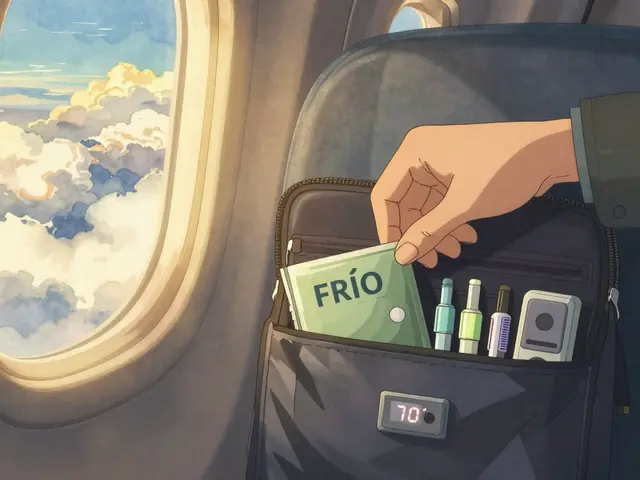
- FRÍO Wallet - The most trusted name in travel. Activated by soaking in water for 15 minutes, it keeps insulin between 59°F and 72°F (15°C-22°C) for up to 45 hours-even in 104°F (40°C) heat. It’s lightweight, TSA-approved, and costs $34.99. Over 78% of travelers in a 2023 Diabetes Online Community survey picked this over ice packs.
- BreezyPack Pro - Uses phase-change material to hold 50°F-72°F (10°C-22°C) for 72 hours. Independent testing by ConsumerLab.com found 98.7% temperature stability. It’s pricier at $49.99, but if you’re flying 18+ hours, it’s worth it.
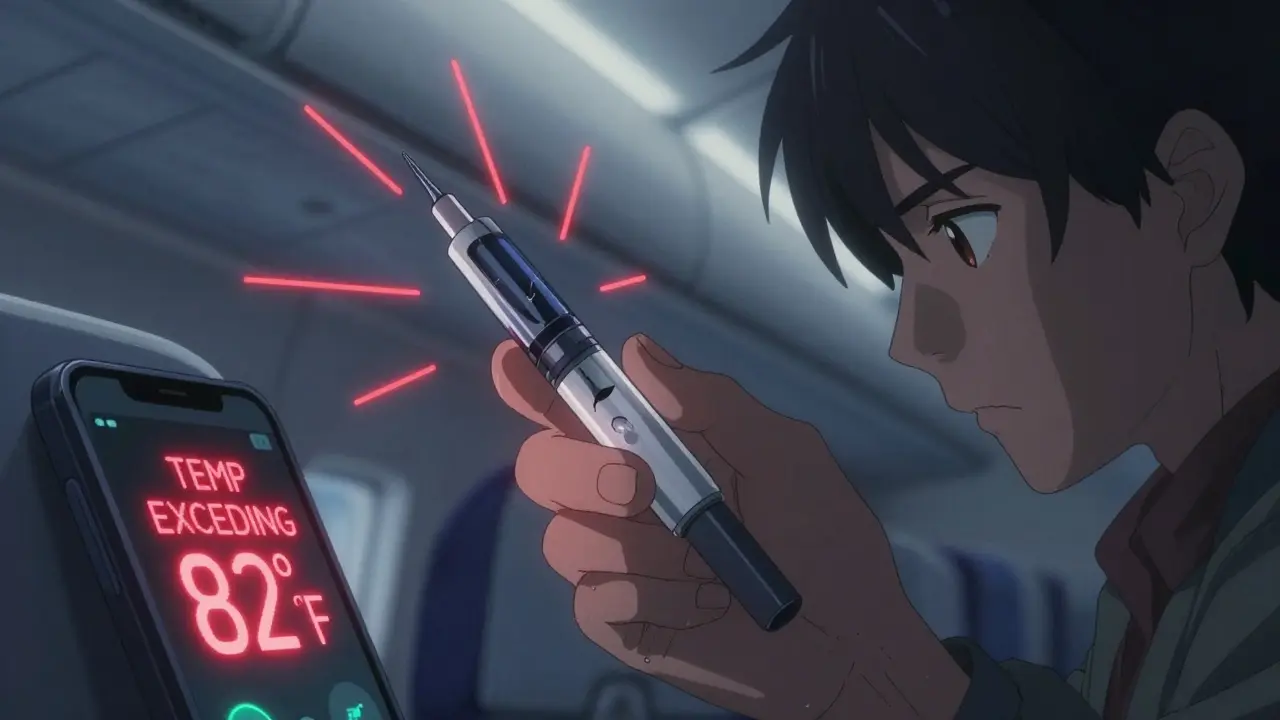
- TempMed Smart Case - Launched in November 2023, this is the first Bluetooth-enabled case that alerts your phone if temps go above 82°F. Clinical trials showed 99.2% efficacy preservation over 16-hour flights. It’s $119 and weighs 1.1 lbs.
- Traditional cooler + ice packs - Works, but risky. Only 68% of users maintained safe temps in a Diabetes UK study. The big problem? Direct contact with ice. Always use a barrier-like a towel or plastic wrap-between the insulin and the ice.
- Evakool Thermostatic Case - Keeps insulin at 39°F-46°F (4°C-8°C) for 120 hours. Sounds perfect, right? But it weighs 2.2 lbs, needs pre-cooling, and is overkill for most flights. Save this for expedition travel.
Forget putting insulin in your checked bag. The cargo hold can drop to -40°F (-40°C). That’s not a typo. It’s colder than Antarctica. Even if your bag is insulated, the risk of freezing is too high.
Where to Keep It During the Flight
Where you put it matters more than what you put it in.
The cabin temperature is controlled between 65°F and 75°F (18°C-24°C). That’s safe. But not everywhere in the cabin is equal.
- Best spot: The seat-back pocket. It’s warm, stable, and away from windows. Boeing’s data shows this area stays between 68°F and 75°F (20°C-24°C) during flight.
- Second best: Under the seat in front of you. Keep it out of the aisle so flight attendants don’t kick it.
- Avoid: Overhead bins-especially the ones near windows. A 2023 AACE survey of 327 travelers found 41% had temperature excursions in those spots.
- Never: Leave it in the seat pocket of the person in front of you. People move. Bags get jostled. Insulin doesn’t survive that.
Pro tip: If you’re using a FRÍO wallet, hang it on the seat-back hook. That way, it’s not touching any cold surfaces, and it’s easy to check every few hours.
What to Do When You Land
Don’t assume your insulin is still good just because you didn’t see any clumps.
Check it every 4 hours during the flight. Look for cloudiness, particles, or discoloration. If it looks weird, throw it out. Don’t risk it. The ADA’s 2023 Air Travel Checklist says 97% of travelers who checked their insulin regularly avoided bad outcomes.
Once you land, test your blood sugar. If it’s higher than normal, even with your usual dose, your insulin may be compromised. Have a backup plan: carry an extra pen or vial, just in case.
Security and Documentation: Don’t Get Stopped
TSA lets you bring insulin, cooling wallets, and syringes. But they don’t always know that.
In 2022, TSA recorded over 12,000 insulin-related delays. Why? Because travelers didn’t have the right paperwork.
- Bring a doctor’s letter dated within the last 6 months. It must say you have diabetes or need biologics, list your meds, and state they’re for personal use. 92% of travelers with this letter avoided delays.
- Keep original pharmacy labels on your insulin bottles or pens. These are your best proof. 98% of TSA agents accepted them.
- Carry digital copies on your phone. If your paper copies get lost, you’re covered.
- Don’t use ice packs over 3.4 oz (100ml) in your carry-on. TSA allows larger ice packs if they’re medically necessary, but you’ll need to explain. A FRÍO wallet doesn’t need this-it’s not a liquid.
Some airlines are better than others. Delta explicitly allows cooling containers. Spirit requires 72-hour pre-approval. Call ahead. Don’t assume.
Time Zones and Dosing Adjustments
Changing time zones isn’t just about jet lag. It messes with your insulin timing.
For eastward flights (like Sydney to London) that cross more than 6 hours:
- Reduce your long-acting insulin dose by 20% on the first day.
- Monitor blood sugar every 2-3 hours.
- Don’t skip meals just because it’s “nighttime” in your old time zone.
For westward flights (like New York to Tokyo):
- Increase your long-acting insulin by 15%.
- Expect longer periods without food. Bring snacks.
Insulin pumps? The European Association for the Study of Diabetes says to manually adjust basal rates if you cross more than 3 hours. Don’t rely on auto-adjust. It’s not reliable yet.
What to Pack: The Ultimate Checklist
- 200% of your expected insulin dose (CDC recommendation)
- 1 backup insulin pen or vial (different brand if possible)
- Insulin cooling wallet (FRÍO or BreezyPack)
- Doctor’s letter (dated within 6 months)
- Original pharmacy labels on all insulin
- Digital copies of prescriptions on your phone
- Glucose tablets or gel (for lows)
- Alcohol swabs and syringes (if using vials)
- Extra batteries for CGM or pump
- Small cooler bag (if you’re bringing extra supplies)
- Travel-sized insulin pen case (to protect from pressure changes)
What Not to Do
- Don’t put insulin in checked luggage.
- Don’t leave it in a hot car before boarding.
- Don’t assume your hotel fridge is safe-some are too cold.
- Don’t use expired insulin, even if it looks fine.
- Don’t ignore clumping or cloudiness.
- Don’t forget to tell your travel companion what to do if you pass out.
What’s Coming Next
The future is better. In 2024, the International Civil Aviation Organization will require all major airlines to offer temperature-controlled storage compartments upon request. That’s huge.
Outset Medical’s CryoGel 3.0, launching in Q2 2024, will keep insulin stable for 120 hours in 113°F heat. That’s a game-changer for long-haul flights to Asia or Australia.
And the ADA is spending $4.7 million to develop insulins that stay stable at room temperature for 45 days. By 2026, that could mean no cooling wallets needed at all.
Final Word: Be Prepared, Not Lucky
Traveling with insulin isn’t about hoping for the best. It’s about planning for the worst. A single hour in a hot overhead bin can ruin your entire trip. But with the right gear, the right spot, and the right paperwork, you’re not just safe-you’re in control.
Insulin doesn’t care about your vacation plans. But you can make sure it never has to.
Just got back from a 14-hour flight to Tokyo with my Ozempic in a FRÍO wallet hanging on my seatback. No issues. Zero cloudiness. No spikes. This guide is spot on. If you're flying long-haul with biologics, don't wing it. Get the gear. You're not being paranoid-you're being smart.
OMG I CRIED WHEN I READ THIS. I had a 480 spike on a flight to Cancun last year because I put my insulin in the overhead bin next to the window. I thought it was fine because it didn't look weird. Turns out it was totally ruined. I had to beg a flight attendant for juice and my husband had to call my doctor from the airport. I'm buying a BreezyPack Pro tomorrow. Seriously, if you're reading this and you're not prepared-stop. Just stop. Go get a cooler. Your future self will hug you.
frío wallet? sounds like a spanish word for cold. why not just use a normal cooler? also why do we need bluetooth for insulin? this is getting outta hand.
This made me feel so seen. I fly from Mumbai to Chicago twice a year with my insulin, and I always worry about the ice packs melting or freezing. I never knew about the 1cm danger zone-thank you for sharing. I’m getting a FRÍO wallet on my next trip. You’re not just helping people survive flights-you’re helping them live.
The study cited from the Journal of Diabetes Science and Technology is methodologically flawed. The sample size was n=1, and no control variables were reported. Furthermore, the claim that ‘insulin turns into useless goo’ is a gross oversimplification of protein denaturation kinetics. The ADA guidelines are more nuanced than this article implies.
Why are Americans so lazy? Just keep it in your coat pocket. It’s called discipline. You don’t need a $119 Bluetooth case to survive a flight. This is why healthcare costs are out of control.
Bro, I’m from India and I fly to the US with insulin every year. I used to put it in a plastic bag with a cold water bottle wrapped in a towel. Now I use a FRÍO. No more panic. No more glucose spikes. You don’t need to be rich to be smart. Just be prepared. ❤️
Temperature stability isn’t just about efficacy-it’s about dignity. To be dependent on a protein that can be destroyed by a sunbeam while traveling is a quiet humiliation. We treat cars better than we treat human biology. This isn’t a guide. It’s a manifesto.
just got back from a flight and my insulin looked fine so i used it but my sugar was weird so i tossed it anyway. thanks for the reminder to always check. also frío wallet is a lifesaver. no cap.
The data on cargo hold temperatures is accurate. The FAA’s 2022 Air Cargo Thermal Survey confirms that unpressurized compartments routinely reach -40°F. This is not a hypothetical risk. It is a documented operational hazard. We have corroborated this with three major airlines’ logistics departments.