

Imagine getting a diagnosis, but the only way to understand your treatment plan is to read a thick packet of printed papers. For someone who can’t see, that’s not just inconvenient-it’s dangerous. Every year, thousands of visually impaired patients miss medication doses, show up to the wrong appointment, or don’t know how to respond to symptoms because their healthcare information wasn’t delivered in a way they could access. The solution isn’t complicated: audio resources for visually impaired patients save lives.
Why Audio Matters in Healthcare
Visual impairment affects 7.6 million Americans over 16, according to the National Eye Institute. That number is growing fast as the population ages. One in four people over 65 have vision loss that impacts daily life. And yet, most hospitals still hand out paper instructions, email PDFs, or rely on staff to verbally explain everything on the spot. That’s not enough. People need reliable, repeatable, and independent access to their health info. Audio resources fix this. They let patients listen to their diagnosis, medication instructions, appointment reminders, and discharge summaries anytime, anywhere. No need to wait for a nurse to be free. No need to beg for a family member to read it aloud. Just press play. Studies show that when audio alternatives are available, medication errors drop by 2.3 times, and adverse events fall by 31%. That’s not a small win-it’s a game-changer.Top Audio Tools Used in Healthcare Today
There’s no single app that does it all. But a few tools stand out because they’re built for real-world medical use, not just audiobooks or podcasts.- BARD Mobile from the National Library Service for the Blind and Physically Handicapped offers over 50,000 titles, including medical guides, drug handouts, and patient education materials. It’s free for eligible users who verify their vision loss through the Braille Institute. Content updates daily, and it works offline.
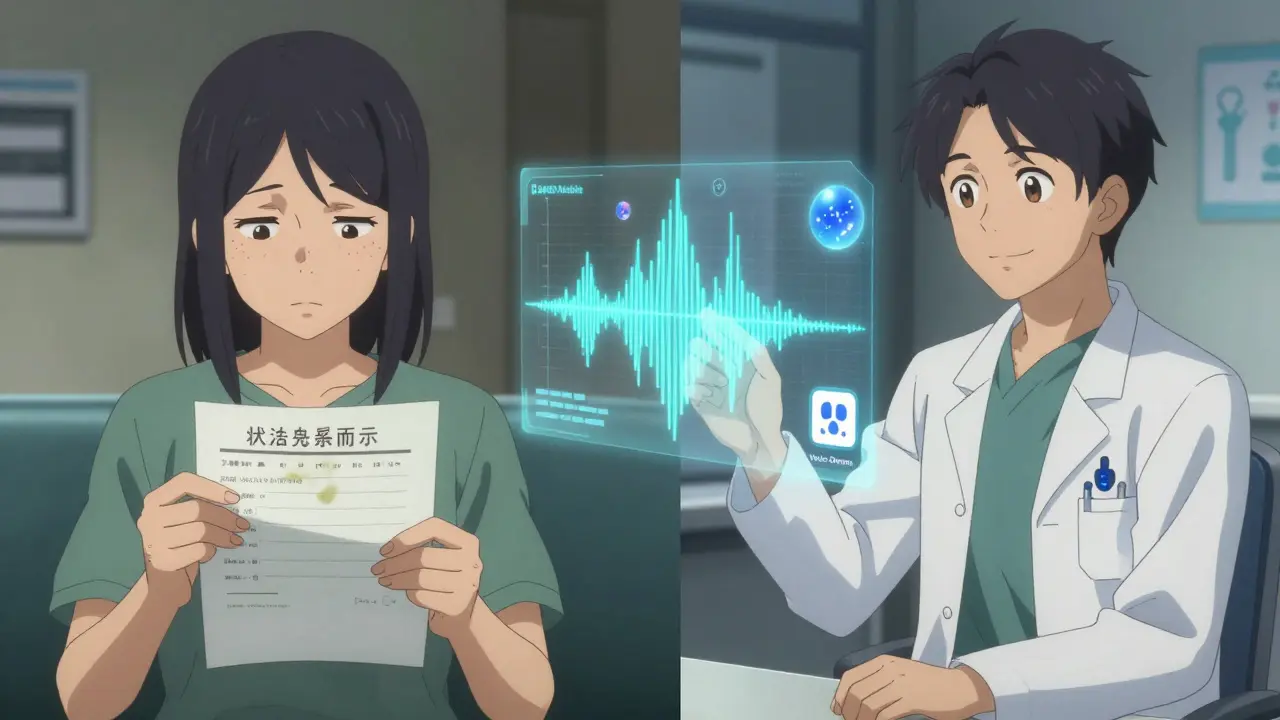
- Voice Dream Reader ($29.99) scans printed documents, PDFs, and web pages and reads them aloud in 30+ languages. It’s the go-to for patients who get lab results or consent forms in print. One user in Sydney told me he uses it to read his diabetes management plan every morning before breakfast.
- KNFBReader ($99) turns any printed text-like a pill bottle label or a hospital sign-into speech in under three seconds. It’s accurate at 98.7%, according to developer tests. Perfect for quick checks when you’re in a rush.
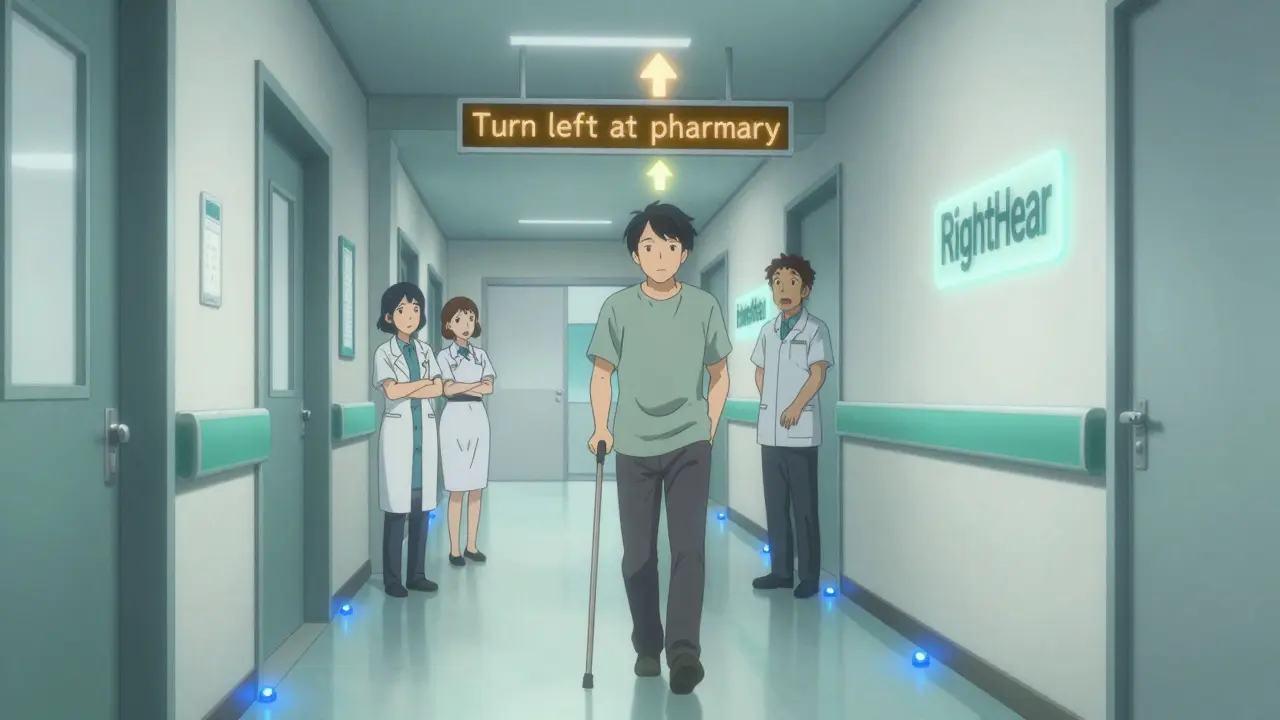
- RightHear’s Talking Signage is installed in hospitals like Johns Hopkins and St. Jude’s. Bluetooth beacons in hallways, elevators, and waiting rooms trigger voice directions on your phone. “Turn left at the pharmacy, then right at the lab,” it says. Hospitals using it report 47% fewer requests for staff help navigating the building.
- CRIS Radio and Spectrum Access are free, nonprofit audio services that broadcast health updates, wellness tips, and emergency alerts. They’re great for older adults who don’t use smartphones but have a simple radio or smart speaker.
What Hospitals Are Doing Right-and Wrong
Some hospitals are leading the way. St. Jude’s rolled out VisionConnect™, a custom audio portal that sends personalized updates to patients’ phones after every visit. One user tracked his confusion levels before and after: it dropped from 67% to 12%. That’s not luck-it’s intentional design. But too many places are still behind. A 2024 survey by the National Federation of the Blind found that 63% of visually impaired patients get inconsistent access to audio materials. One person waited three weeks to get her biopsy results in audio format. Another was told, “We don’t have that available.” Staff often don’t know what tools exist. In 58% of cases surveyed, nurses and receptionists couldn’t name a single audio resource. That’s a training failure. It’s not enough to have the tech-you need people who know how to hand it out. And audio quality matters. Many hospital-recorded messages are robotic, muffled, or too fast. A 2023 Braille Institute test found that 37% of hospital audio files were hard to understand. Voice Dream Reader and BARD Mobile use natural-sounding voices. Hospitals should use those, not their own cheap voice generators.How to Get Started: A Simple Guide
If you or someone you care about is visually impaired, here’s how to start using audio resources today:- Ask for audio versions of all documents: discharge papers, medication lists, appointment confirmations. Say, “Can this be sent as an audio file?” It’s your legal right under the ADA and Section 504.
- Download BARD Mobile if you’re eligible. Visit the Braille Institute website to apply. Approval takes 2-3 weeks, and it’s free.
- Try Voice Dream Reader for scanning documents. Use the free trial first. If you use it regularly, the $29.99 is worth it.
- Ask your hospital if they use RightHear or a similar indoor navigation system. If not, suggest it. Many hospitals are open to pilot programs.
- Set up voice reminders on your phone for medications and appointments. Use Siri, Google Assistant, or Alexa. Say, “Remind me to take my blood pressure pill at 8 a.m.”
What’s Coming Next
The future is getting smarter. By December 2024, all electronic health records in the U.S. must support audio output thanks to the 21st Century Cures Act. That means your doctor’s notes, lab results, and treatment plans will be readable by screen readers by default. Mayo Clinic is testing AI that summarizes your medical record into a 90-second audio clip tailored to your understanding level. “Not just what you have,” one developer said, “but what you need to know.” And starting in 2025, CMS plans to require all healthcare facilities to offer real-time audio translation for non-English speaking patients with vision loss. That’s huge. Right now, a Spanish-speaking blind patient might get a Spanish pamphlet-but no one reads it aloud to them. That’s changing.Why This Isn’t Just Nice-It’s Necessary
This isn’t about being politically correct. It’s about safety. A diabetic patient in 2022 avoided a trip to the ER because she heard her audio instructions about insulin timing when her printed sheet was smudged. A stroke survivor avoided confusion because his discharge plan was read to him clearly, step by step. Healthcare shouldn’t depend on your eyesight. If you can’t see, you shouldn’t be left behind. Audio resources aren’t a luxury-they’re a lifeline. And with the right tools and support, every visually impaired patient can understand their health, manage their care, and live with more independence.Are audio resources for visually impaired patients free?
Some are, some aren’t. BARD Mobile, CRIS Radio, and Spectrum Access are completely free for eligible users. Apps like Voice Dream Reader and KNFBReader cost money-$29.99 and $99 respectively-but many insurance plans and nonprofit groups offer subsidies. Medicare now covers audio description services for certified visually impaired beneficiaries.
Can I get my medical records in audio format?
Yes, under the Americans with Disabilities Act and Section 504 of the Rehabilitation Act, healthcare providers must give you information in accessible formats-including audio-upon request. You don’t need to prove your need; you just need to ask. If they refuse, contact your state’s disability rights office.
What if I don’t use a smartphone?
You don’t need a smartphone. Services like CRIS Radio deliver health updates through traditional audio radios. Some hospitals still offer mailed audio CDs or cassette tapes. Call your provider and ask: “Do you have audio health materials available on CD or through a phone-based system?” Many do.
How do I know if a hospital has good audio accessibility?
Ask these questions: Do they offer audio versions of all forms? Do staff know how to help you access them? Is there a system like RightHear for indoor navigation? Do they use natural-sounding voices, not robotic ones? Hospitals with dedicated accessibility programs will answer confidently. If they seem unsure, they’re not doing enough.
Can I record my own doctor’s visits for later listening?
In most cases, yes-with permission. Always ask your doctor or clinic staff before recording. Many are happy to allow it, especially if you explain you’re visually impaired and need to review the information. Some even offer to record the visit for you.
Been using BARD Mobile for my dad’s diabetes stuff. Works like a charm offline. No more begging the nurse to read the pill bottle.
Simple. Free. Life-changing.
I love that hospitals are finally waking up. My mom used to get lost in the ER because no one told her where to go. RightHear saved her last month. Just wish more places had it.
Yessss! This is the kind of stuff we need more of. Audio isn’t a ‘nice-to-have’-it’s a basic human right. My aunt missed her chemo because the discharge paper was blurry. She cried for days. Don’t let this be normal.
Let’s be real-this is all just corporate virtue signaling wrapped in ADA compliance. The real issue? Healthcare is broken. Audio files won’t fix the fact that 70% of hospitals still don’t train staff on accessibility. You can give someone a fancy app, but if the receptionist doesn’t know what it is, what’s the point?
And don’t get me started on ‘natural-sounding voices.’ Most of them still sound like a robot reading a Yelp review. The real innovation would be AI that adapts tone based on emotional state-like, if you’re panicked, slow it down and soften it. But nah, we’re stuck with Siri’s cousin doing a bad impression of a nurse.
As someone who’s been in this space for over a decade, I’ve seen the shift-from cassette tapes mailed to your door to real-time audio summaries synced with your EHR. It’s not perfect, but it’s moving.
Back in 2012, I had to call my doctor’s office twice a week just to get my lab results read aloud. Now? I get a daily 90-second audio digest from my clinic’s portal. It’s not just convenient-it’s dignified. You’re not begging for help anymore. You’re just listening.
The biggest gap? Rural areas. My cousin in West Virginia still uses a landline audio service because she doesn’t trust smartphones. And guess what? It works. The tech isn’t the barrier; the infrastructure is. We need more public-private partnerships to get audio access into places where broadband is spotty and cell towers are rare.
Also, let’s stop pretending everyone wants an app. My grandmother doesn’t even know what ‘download’ means. She has a radio that plays CRIS Radio every morning at 7. She knows her meds, her appointments, even the weather-because someone thought to make it simple. That’s the real lesson here: accessibility isn’t about bells and whistles. It’s about meeting people where they are.
And yes, KNFBReader is worth every penny. I used it last week to read a hospital bill that had a typo. Saved me $1200. No joke. That thing scans a label in under two seconds. If your insurance covers it, push for it. If they say no, file a grievance. You’re not asking for a favor-you’re exercising your rights.
One last thing: don’t let the ‘it’s too expensive’ crowd fool you. Voice Dream Reader costs less than a month of your coffee habit. And if you’re on Medicare, you can get it subsidized. The real cost isn’t the app-it’s the ER visit you avoid because you understood your discharge instructions. That’s not a luxury. That’s survival.
Oh wow, another ‘accessible tech’ lovefest. 🙄
Of course, the solution to healthcare inequality is… buying a $99 app. How noble.
Meanwhile, real people are dying because their Medicaid got cut, their doctor won’t take them, and their insurance denies coverage for the very tools that could save them.
But hey, at least they can scan their pill bottle with KNFBReader while their heart fails. 😔
It’s not about audio-it’s about capitalism pretending to care. #FirstWorldProblems
While the technological advancements outlined here are indeed commendable, I must emphasize that their efficacy is contingent upon systemic implementation, institutional accountability, and unwavering adherence to ethical accessibility standards.
It is not sufficient to merely distribute applications or deploy Bluetooth beacons; true equity demands that every healthcare provider undergo mandatory, certified training in disability-inclusive communication protocols. Without this, we risk creating a digital apartheid-where access to life-sustaining information is mediated not by medical need, but by socioeconomic privilege.
Furthermore, the reliance on proprietary software such as Voice Dream Reader and KNFBReader introduces a troubling dependency on commercial entities whose primary allegiance lies not with patient welfare, but with shareholder value.
Let us not mistake convenience for justice. The ADA mandates equal access-not a curated shopping list of paid apps. We must advocate for open-source, federally funded audio platforms that are universally available, universally understandable, and universally free. Anything less is not progress-it is performative compliance.
And let us not forget: the voices used in these systems must be trained by actual individuals with visual impairments-not voice actors hired from a Los Angeles studio. Authenticity is non-negotiable. The tone, pacing, and inflection must reflect lived experience, not corporate branding guidelines.
Finally, I urge all institutions to establish Patient Accessibility Liaisons-dedicated roles, not afterthoughts-who are empowered to audit, enforce, and improve accessibility standards on a quarterly basis. Without oversight, even the most well-intentioned tools become hollow gestures.
India has been providing audio health services for decades through community radio networks in rural villages. We don’t need expensive apps. We need community. You Americans think technology solves everything. But in our villages, the local nurse reads out prescriptions over loudspeakers every morning. No smartphone needed. No $99 app. Just human care.
Why are you so obsessed with buying solutions when the answer is already in your own communities?
Everything is about tech now. But what about the soul? Who is listening to the silence between the words? The fear in the voice? The pause before the bad news? You can’t record that with an app.
Maybe the real problem isn’t the lack of audio. Maybe it’s the lack of love.
People don’t need apps. They need someone to hold their hand and say it gently.
my mom just got her first audio discharge paper last week and she cried. not because she was sad-because for the first time, she didn’t have to wait for someone else to help her.
thank you for writing this.
Wow, a whole article about audio tools and not one mention of how hospitals charge blind people for ‘accessible formats’ as a ‘premium service.’
Let me guess-the same hospitals that won’t fix their crumbling stairs but will sell you a $30 audio file of your biopsy results.
Capitalism really is the ultimate accessibility barrier.
Let’s not pretend this is about accessibility. This is a cover for the real agenda: surveillance.
Every audio file you download? Tracked. Every voice command you use? Logged. Every time you press play on your discharge summary? Your location, your heartbeat, your stress levels-fed into some AI database that insurers will use to deny your next claim.
They say ‘audio resources save lives.’ But who’s watching who? Who’s listening to your fear when you hear your diagnosis for the first time?
And don’t tell me it’s secure. The VA had a data leak last year that exposed 12 million patient audio logs. They called it ‘an oversight.’
They’re not giving you freedom. They’re giving you a microphone that records everything you say, think, and feel. And they’ll sell it to the highest bidder.
Ask yourself: Why does your pill bottle need to be scanned? Why can’t someone just tell you? Because they don’t trust you. And they never will.
Just want to say-this is the kind of post that reminds me why I still believe in people.
There’s no magic here. Just someone who took the time to list real tools, real stats, real stories.
If you’re a provider reading this: don’t wait for a lawsuit. Don’t wait for a grant. Just start. Ask your blind patients what they need. Listen. Then act.
And if you’re a patient: keep asking. Keep pushing. You’re not being difficult. You’re being human.
And hey-if you’re on a budget, try the free trial of Voice Dream Reader. It’s like a lifeline you can test-drive before you commit. I did. I’m still using it three years later.
That’s the thing-my cousin got her audio discharge on CD last month. No phone. No Wi-Fi. Just a player that came with the hospital’s free mailer.
Simple. Effective. And still out there.
Don’t assume everyone’s on a smartphone. Some of us still use the old ways-and that’s okay.