
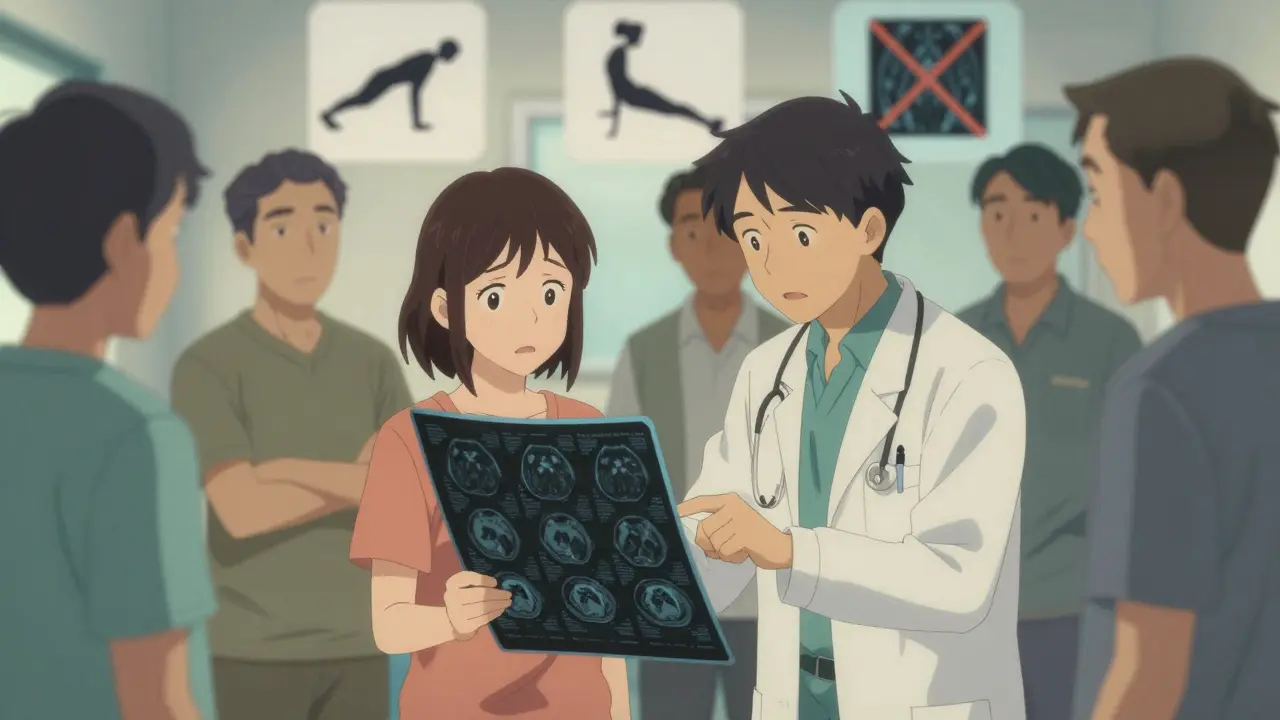
Low back pain isn’t just a nuisance-it’s a global health issue. About 80% of adults will deal with it at some point in their lives. Most of the time, it’s just a strained muscle or a stiff joint. But sometimes, it’s a warning sign of something far more serious. Knowing the difference can save you from unnecessary scans, costly treatments, or even permanent nerve damage.
Most Back Pain Isn’t Dangerous-But How Do You Know?
Here’s the truth: 97 out of every 100 cases of low back pain are mechanical. That means no tumor, no infection, no broken bone. It’s just your body reacting to movement, posture, or overuse. The problem? Doctors and patients alike often treat all back pain like it’s a red alert. And that’s where things go wrong.
Imaging-like X-rays or MRIs-sounds like a smart move. But for the vast majority of people with plain old back pain, it’s not just unnecessary. It’s misleading. Studies show that up to 90% of people over 40 have disc bulges or degeneration on MRI-even if they feel zero pain. Finding those changes doesn’t tell you why you hurt today. It just creates anxiety, more tests, and sometimes surgery you don’t need.
The real goal? Spot the rare 1-2% of cases where something dangerous is going on. That’s where red flags come in.
What Are Red Flags? And Which Ones Actually Matter
Red flags are warning signs that something more serious might be causing your pain. They’re not symptoms you panic over. They’re clues that trigger a deeper look.
There are 46 different red flags listed across guidelines. But here’s the kicker: only two show up in over 75% of them-history of cancer and major trauma. Everything else? Mixed evidence.
Let’s break down the real ones:
- History of cancer - If you’ve had cancer before, especially breast, lung, prostate, or melanoma, any new back pain needs attention. Cancer can spread to the spine.
- Unexplained weight loss - Losing more than 5% of your body weight in 6 months without trying? That’s a red flag. Not because of diet. Because of illness.
- Major trauma - A car crash, fall from height, or direct blow to the back. If you’re over 50 and had a fall, even a small one, get checked. Bone density drops with age.
- Bladder or bowel problems - Can’t control pee? Can’t feel when you need to go? That’s not just inconvenient. It’s a sign of cauda equina syndrome. This is an emergency. If you have this plus numbness in your saddle area (buttocks, inner thighs, genitals), you need an MRI within hours.
- Urinary retention - If you can’t fully empty your bladder and your post-void residual is over 200cc, your risk of cauda equina jumps to 92%.
- Fevers or night sweats - If your back hurts worse at night or you’re running a low-grade fever, infection could be the culprit. Especially if you’ve had IV drug use, recent surgery, or a spinal injection.
- Vertebral tenderness - If you press on your spine and it hurts sharply, that’s different from general muscle soreness. Combined with fever, it’s a strong signal for infection.
Now, here’s what doesn’t count:
- Age over 50 or 55
- Being overweight
- Pain that gets worse with movement
- Stiffness in the morning
These are common, but they’re not red flags. A 2022 survey found that nearly 70% of doctors still think age alone is a reason to scan. That’s outdated. Age doesn’t predict serious disease on its own.
When Should You Get Imaging? (And When to Avoid It)
Let’s cut through the noise. Imaging isn’t bad. It’s just not needed for most people.
Do NOT get imaging if:
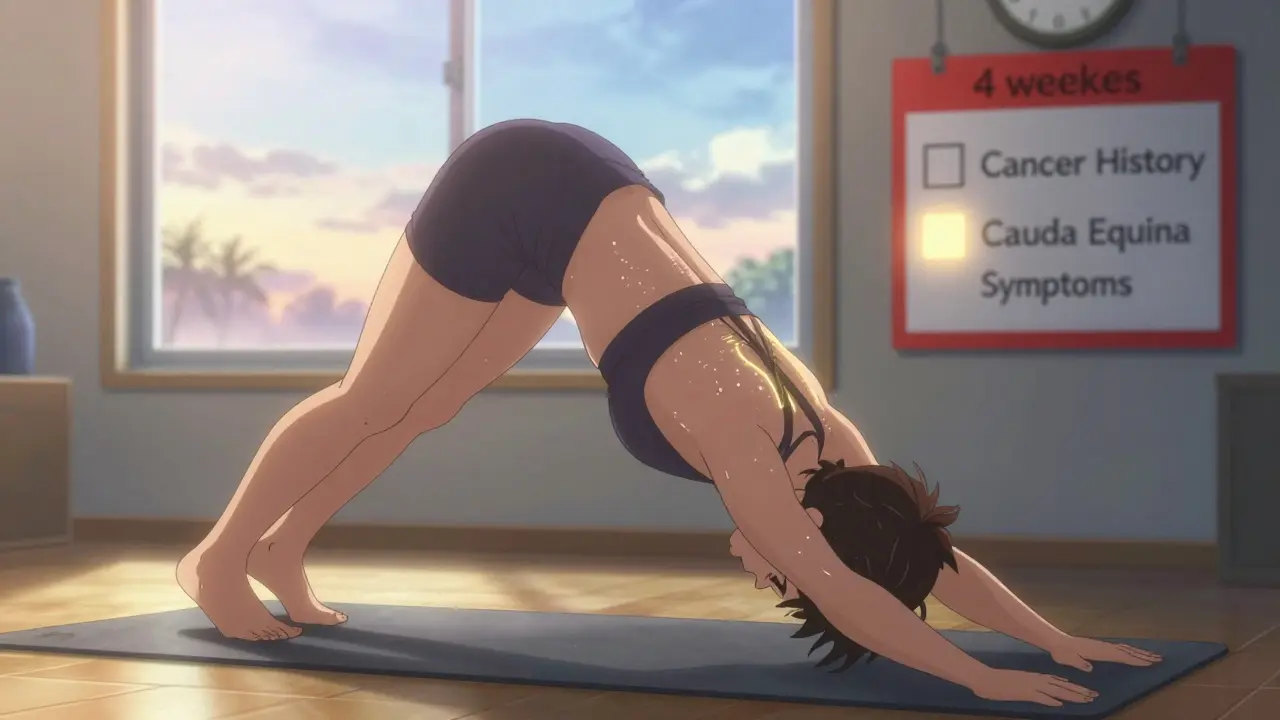
- Your pain started less than 4 weeks ago
- You have no red flags
- You’re otherwise healthy
The American College of Radiology says: Not appropriate. That’s their highest level of caution. X-rays and MRIs won’t help you feel better faster. They’ll just show you things you can’t unsee.
Do get imaging if:
- You have cauda equina symptoms (bladder issues + numbness) → Urgent MRI
- You have history of cancer + new back pain → MRI without contrast
- You have fever + spine tenderness → Bone scan with SPECT/CT or CT with contrast
- Pain lasts more than 6 weeks and you have red flags → MRI
For chronic pain without red flags? No need for X-rays. They’re terrible at finding tumors or infections. A 2019 Canadian guideline called them “very poor indicators.”
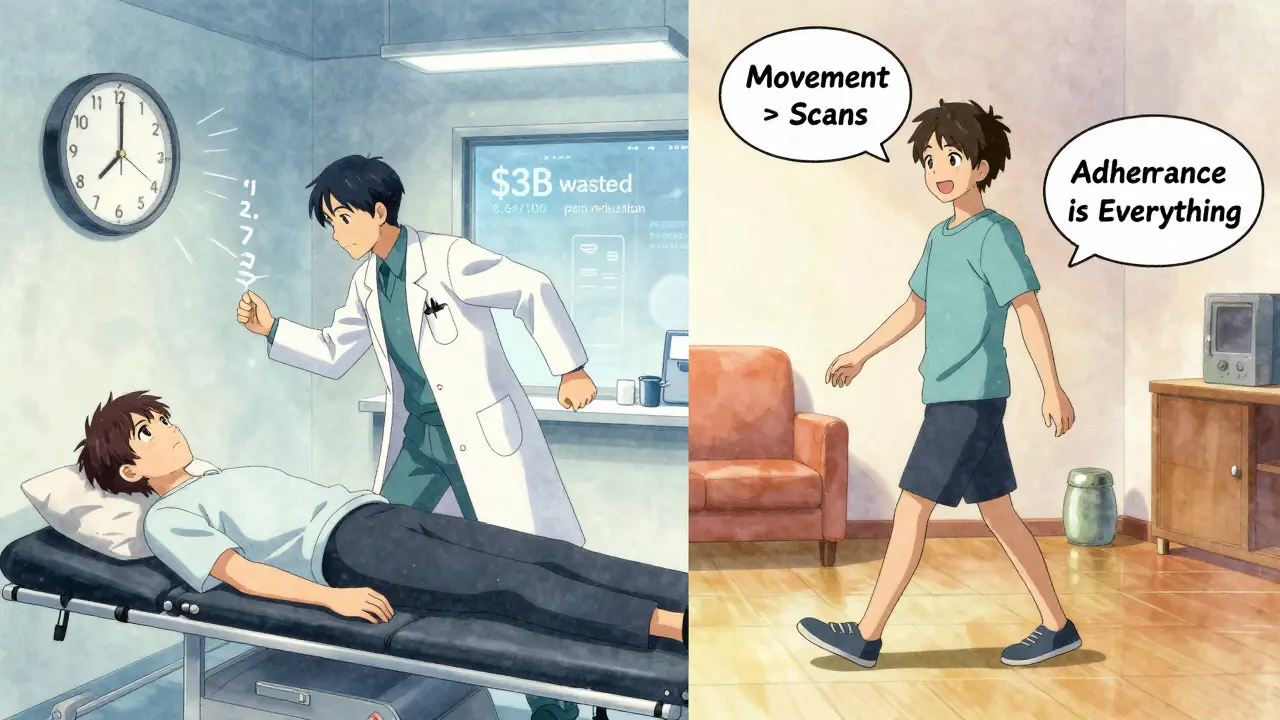
And here’s the kicker: unnecessary imaging costs the U.S. alone $3 billion a year. Most of it for people who didn’t need it.
Exercise Therapy: The Only Treatment That Works Long-Term
If you’ve been told to rest, sit still, or avoid movement-you’ve been misled.
Science is clear: Exercise is the most effective treatment for low back pain. Not pills. Not injections. Not braces. Exercise.
A 2020 Cochrane Review looked at 97 studies with nearly 20,000 people. The result? Exercise reduced pain by 6.64 points on a 100-point scale and improved function by the same amount. That’s not a tiny improvement. That’s life-changing.
Not all exercise is equal. Here’s what works best:
- Motor control exercises - These teach you how to activate deep core muscles correctly. Think pelvic tilts, bird-dogs, dead bugs. Effect size: 0.61.
- Graded activity - Start with light movement, slowly increase time and intensity. Great for people who fear movement. Effect size: 0.52.
- Combined programs - Mix strength, aerobic, and flexibility. Most practical for most people. Effect size: 0.58.
You don’t need a gym. You don’t need fancy equipment. Just consistency.
The American Physical Therapy Association recommends:
- 2-3 supervised sessions per week for 4-6 weeks
- Then switch to a home program
- At least 8-12 weeks total
- Strength work: start at 40-60% of your max lift, build to 70-85%
- Aerobic: 20-30 minutes, 3-5 days/week at 60-80% of max heart rate
And here’s the truth most people miss: Adherence is everything. If you do less than half the recommended sessions, benefits drop sharply. It’s not about intensity. It’s about showing up.
Why Do So Many People Get the Wrong Care?
Time. Pressure. Misinformation.
A 2022 survey of over 1,200 doctors found that most spend just 12.7 minutes per back pain visit. The recommended time? 18-22 minutes. That’s not enough to ask about weight loss, bladder control, or past cancer. So they default to the easiest thing: order a scan.
Patients? They want answers. Scans feel like progress. But they’re not. A 2021 study found that 34.6% of patients didn’t get proper red flag screening because doctors ran out of time.
And then there’s the myth: “If it hurts, something’s broken.” That’s not true. Pain doesn’t equal damage. In fact, chronic pain often has little to do with tissue injury. It’s your nervous system on high alert.
Tools like the Red Flag Decision Tool help. It’s a simple 3-step check: 1) Is there cancer history? 2) Any neurological warning signs? 3) Did trauma happen? If yes to any, act. If no, start moving.
The Choosing Wisely campaign has already cut unnecessary imaging by 15% in the U.S. by teaching doctors to ask: “Will this change what we do?” If the answer is no-don’t do it.
What Should You Do Right Now?
If you have low back pain:
- Don’t panic. Most cases aren’t dangerous.
- Check for red flags. Cancer history? Unintentional weight loss? Bladder issues? Fever? Trauma? If yes, see a doctor within 24 hours.
- If no red flags: Stay active. Walk. Stretch. Do light core exercises. Avoid bed rest.
- Start an exercise program. Even 10 minutes a day of movement helps. Build up slowly.
- Don’t rush to imaging. Wait at least 4-6 weeks unless red flags appear.
Back pain doesn’t have to be a life sentence. It doesn’t need a scan. It needs movement, patience, and the right information.
Is it normal for back pain to get worse at night?
Night pain can be a red flag, but not always. Mild discomfort that improves with movement is common with muscle strain. But if your pain is sharp, constant, and wakes you up-even after taking painkillers-it could signal infection, cancer, or inflammation. Combine it with fever, weight loss, or a history of cancer, and you need medical evaluation.
Can exercise make back pain worse?
Only if you do it wrong. Starting too hard, using poor form, or doing high-impact moves too soon can flare pain. But pain during exercise doesn’t mean damage. It usually means your body isn’t used to the load. The key is to stay within a 3-5/10 pain scale during activity and avoid sharp, shooting, or radiating pain. A physical therapist can help you find the right starting point.
Do I need an MRI if my pain lasts more than 6 weeks?
Not necessarily. Most chronic back pain (lasting over 6 weeks) is still mechanical, even if it lingers. MRI is only recommended if you have red flags or if pain hasn’t improved after 8-12 weeks of consistent exercise and activity. Many people with severe disc degeneration on MRI feel fine. Imaging without symptoms doesn’t change treatment.
Are opioids or painkillers the best solution for back pain?
No. Painkillers may offer short-term relief, but they don’t fix the cause. Long-term use increases risk of dependence, side effects, and doesn’t improve function. Guidelines from the American College of Physicians strongly recommend against opioids for chronic low back pain. Exercise, education, and movement-based therapy are safer and more effective.
What’s the best exercise for low back pain?
There’s no single “best” exercise. The most effective approach is a mix of movement types: light aerobic activity (walking, cycling), core stabilization (bird-dogs, planks), and strength training (squats, deadlifts with light weight). The key is consistency over intensity. Choose something you’ll stick with-even if it’s just 10 minutes a day.
Man, this post is a godsend. I’ve been telling my coworkers for years that MRIs aren’t magic bullets for back pain. I had one last year after a ‘bad lift’-turned out I had a bulge that was there since 2018. No symptoms then. No symptoms now. Just a pretty picture that made me paranoid for six months. The real fix? Walking 30 minutes a day. No gym. No fancy gear. Just shoes and a stubborn attitude. Science says so. My back says so. You’re welcome.
like omg i was just reading this and i thought ‘wait did they say 90% of people over 40 have disc bulges??’ like… that’s wild. i mean, i’m 38 and i’ve never even seen a doctor for back stuff. i just stretch and yell at my chair. but like… if everyone has these ‘bulges’ then why are we all so scared? also i think the word ‘mechanical’ sounds like a robot wrote it. just saying. 🤷♀️
Let’s be brutally honest: the entire ‘exercise therapy’ narrative is a placebo dressed in Lululemon. Yes, movement helps. But you’re ignoring the fact that 60% of patients who do ‘motor control exercises’ report no improvement after 12 weeks. The Cochrane Review you cite? It’s meta-analysis hell-heterogeneous populations, inconsistent protocols, publication bias. And don’t get me started on ‘graded activity.’ That’s just behavioral therapy with a fitness label. Meanwhile, the opioid crisis was weaponized to push this agenda. Pain is complex. Reducing it to ‘move more’ is lazy. And yes, I’ve had chronic LBP for 14 years. I know.
Oh sweetie. You really think a 10-minute walk is going to fix what your spine’s been screaming about for months? I’ve seen people do yoga, Pilates, even ‘dead bugs’-and then they’re in a wheelchair six months later. The system’s broken. Doctors don’t have time. Patients don’t have money. And now we’re supposed to trust ‘consistency’? Honey, consistency doesn’t pay your rent. Or your physical therapist’s $200/hr fee. I’m not saying don’t move. I’m saying: who’s really benefiting here?
Okay, I’m gonna go full contrarian here. You say imaging is useless? Then why do so many people get better after an MRI? I know someone who had a ‘benign’ bulge on their scan, got scared, saw a specialist, did physical therapy, and now they’re hiking in Patagonia. Meanwhile, I’ve got a coworker who ‘trusted the science,’ stayed active, and now has radiculopathy because no one checked for a tumor. The 97% statistic is comforting, but what about the 3%? The ones who slip through? I don’t care if it’s ‘expensive’-I’d rather spend $3,000 on a scan than risk paralysis. And don’t even get me started on ‘exercise.’ What if you can’t move? What if you’re disabled? What if your pain is neurological? This post feels like a marketing brochure for a chiropractor who doesn’t believe in X-rays.
They don’t want you to know this, but the real reason they don’t want you to get MRIs is because the government and Big Pharma are in bed with the physical therapy industry. You think exercise is free? It’s not. It’s a trap. They want you to spend hours doing bird-dogs so you never go to the doctor and find out you have spinal cancer. They also hide the fact that 80% of ‘disc degeneration’ is caused by 5G radiation. And don’t get me started on fluoride in the water. It weakens your spine. I’ve got a chart. I’ll send it. You’re being manipulated.
Yessss. This. I’ve been a PT for 12 years and I’ve seen too many people get scared into surgery because someone told them their MRI looked ‘terrible.’ I had a client last month-62, no red flags, just ‘aching all the time.’ We started with walking, then added bodyweight squats, then bird-dogs. Three months later, she’s gardening again. No scans. No pills. Just patience and a little love. You don’t need a fancy machine to heal. You need to trust your body. And maybe a good playlist.
Red flags? Only two matter? That’s laughable. You’ve ignored the most critical one: age. And yes, I mean age. Osteoporosis. Degeneration. Loss of proprioception. You think a 70-year-old who falls off a curb shouldn’t get scanned? That’s not ‘outdated’-that’s negligent. And exercise? You say ‘consistency’ is everything? Then why do 40% of patients quit after two weeks? Because pain is scary. Because fear is real. Because you’re not addressing the psychological component. This isn’t a fitness blog. It’s medicine. And medicine requires nuance. Not slogans.
They’ve been lying to us for decades. The ‘move more’ narrative? It’s a cover-up. Why? Because if people knew that most back pain is caused by toxins-EMFs, mold, glyphosate-they’d sue the CDC. The pharmaceutical industry doesn’t want you to heal naturally. They want you dependent. I’ve had back pain since 2010. I’ve done everything. Chiropractors. Acupuncture. Yoga. Nothing worked. Then I found out I had chronic mold exposure. My spine was inflamed from my own home. No scan. No exercise. Just detox. Now I’m pain-free. You think that’s coincidence? It’s not. They’re silencing this. You’re being gaslit.
Look I dont care about your science. I work construction. My back hurts. I dont have time for bird dogs. I need to work. If I cant work I cant eat. So I take ibuprofen. I ice it. I keep moving. And if I cant move? I get the scan. You think I care about 3 billion dollars? I care about my kid. You dont know my life. Dont lecture me about consistency. I dont have consistency. I have survival.
My brother had cauda equina. He waited three days because he thought it was ‘just a pulled muscle.’ He’s in a wheelchair. Don’t downplay red flags. Ever.
Let me break this down for you: the entire ‘avoid imaging’ stance is a luxury of the healthy and the privileged. My wife has fibromyalgia. She’s 42. She’s had back pain for 11 years. She’s had three MRIs. Two were normal. One showed a herniation. That one changed everything. She got targeted therapy. She’s walking again. You think we should’ve just ‘moved more’? We did. It made her worse. Your statistics are cold. Real people aren’t data points. They’re mothers. They’re fathers. They’re scared. And sometimes, a scan is the only thing that gives them back their life.
Yall in the US overthink everything. In my town we just lift heavy and shut up. Back pain? Do more deadlifts. If it hurts you’re weak. If it don’t hurt you’re strong. No scans. No PT. No yoga. Just steel. And grit. This post is a joke. The real solution? Build muscle. Not ‘core stability.’ Not ‘bird-dogs.’ Just lift. Hard. Everyday. That’s how we did it in the 80s. And we didn’t need a PhD to tell us.
Interesting. I live in India. Back pain is everywhere. But we don’t have MRIs or PT. We have local healers. Ayurveda. Massage. Hot oil. Sometimes it works. Sometimes it doesn’t. But nobody freaks out. Nobody blames the spine. We just keep moving. Walk. Sit. Bend. Sleep. Eat. Repeat. Maybe the answer isn’t in the scan. Maybe it’s in the rhythm.
I’m a nurse who’s seen this play out a hundred times. The most dangerous thing isn’t the pain. It’s the fear. The moment someone sees a ‘bulge’ on an MRI, they freeze. They stop moving. They lose confidence. They become dependent. The real healing? Starts when they realize: ‘My body is still mine.’ You don’t need to fix the disc. You need to rebuild trust in your movement. Start with breath. Then walk. Then stand. Then squat. One step. One day. One breath. That’s how people heal. Not with scans. Not with pills. With patience.