
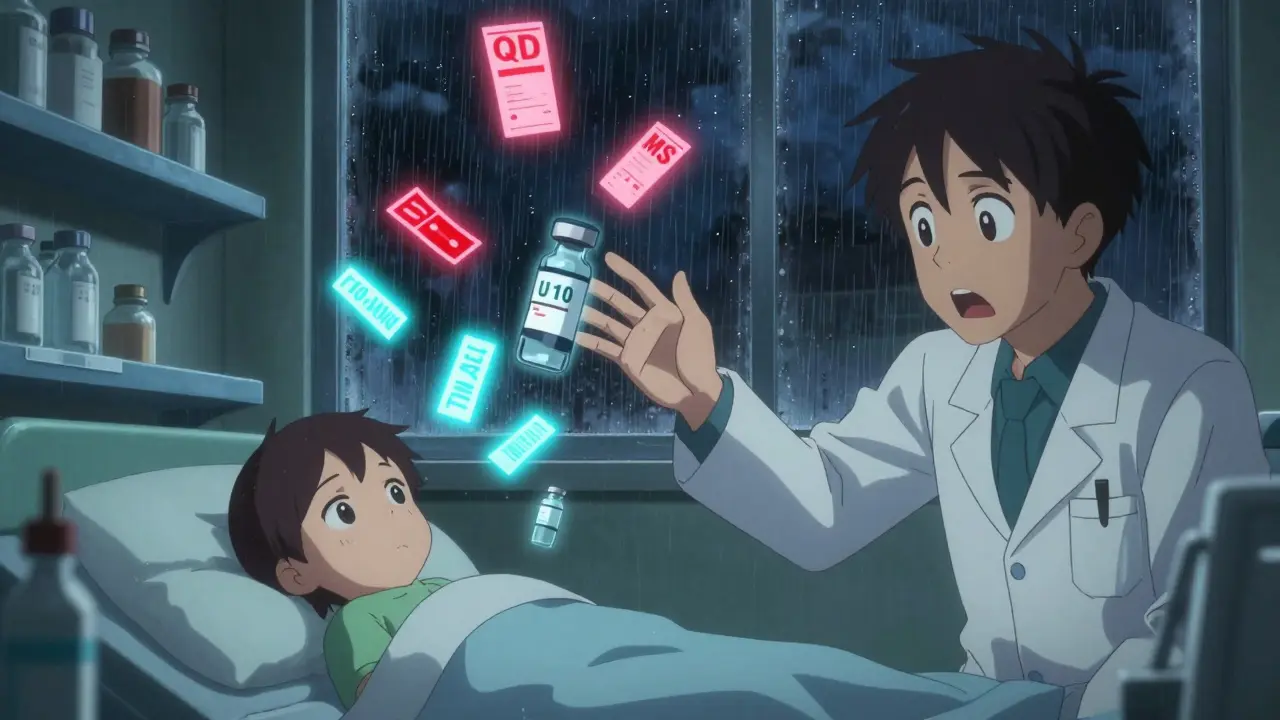
Every year, thousands of patients are harmed because a doctor wrote a quick note on a prescription - something as simple as QD, MS, or U. These aren’t typos. They’re dangerous abbreviations that have caused overdoses, allergic reactions, and even deaths. And despite decades of warnings, they’re still showing up in prescriptions today.
Why These Abbreviations Are So Dangerous
Medical abbreviations aren’t just shortcuts. They’re shortcuts that can kill. The problem isn’t that doctors are careless - it’s that some abbreviations look too similar to others, or mean different things depending on who reads them. A handwritten QD (once daily) can easily be mistaken for QID (four times daily). A quick U for unit can look like a zero or a 4. And MS? That could mean morphine sulfate - or magnesium sulfate. Two completely different drugs. One calms pain. The other stops seizures. Mix them up, and you’re risking cardiac arrest. The Joint Commission and the Institute for Safe Medication Practices (ISMP) first put out a formal Do Not Use list back in 2001. Since then, they’ve tracked over 4,700 medication errors tied to these abbreviations. The most common? QD. It’s responsible for over 43% of all abbreviation-related errors. Why? Because it’s easy to misread, especially in handwriting. A pharmacist sees QD and thinks, “Oh, that’s probably QID.” The patient gets four times the dose they were supposed to. That’s not a rare mistake. It happens daily in hospitals, clinics, and pharmacies.The Top 6 Dangerous Abbreviations You Must Avoid
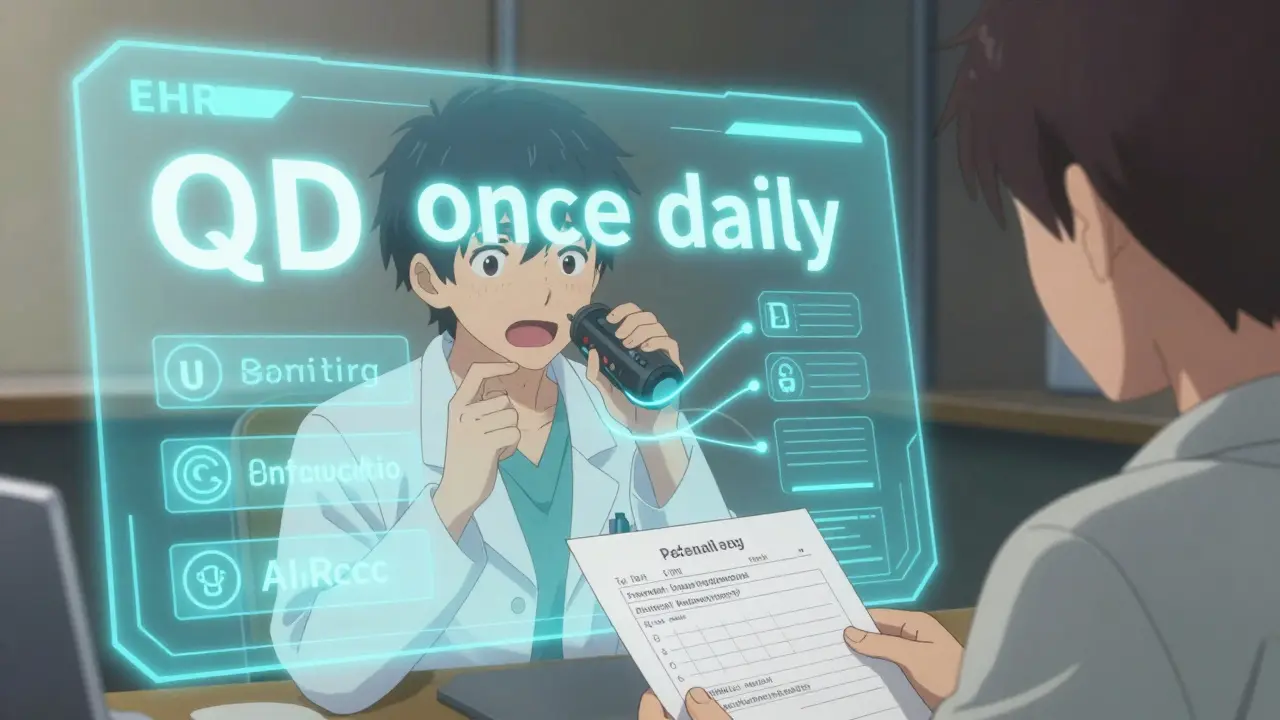
Here are the six most dangerous abbreviations still showing up on prescriptions - and what to write instead.- QD - Never use this. It looks like QID or QOD. Write: once daily.
- QOD - Means every other day. But it’s often read as “every day” or “four times a day.” Write: every 48 hours.
- U - Stands for unit. Looks like a zero, a 4, or even “cc.” Write: unit.
- MS or MSO4 - Could be morphine sulfate or magnesium sulfate. These drugs have opposite effects. Write: morphine sulfate or magnesium sulfate.
- cc - Cubic centimeters. People confuse it with “U” (units). Write: mL (milliliters).
- IU - International unit. Looks like “IV” (intravenous) or “10.” Write: international unit.
What Happens When You Get It Wrong
Real stories show how quickly things go wrong. In one case, a patient was prescribed MS 10 mg SC. The pharmacist saw “MS” and thought it was magnesium sulfate - a drug used for preeclampsia. The patient, however, was supposed to get morphine sulfate for pain. The pharmacist caught it just in time. That’s a near-miss. In another case, a nurse gave a child U 10 instead of 10 units. The “U” was misread as “10,” so the child got 100 units of insulin. The child went into a coma. They survived, but barely. A 2022 survey of 1,843 pharmacists found that 63.7% had intercepted a dangerous abbreviation error in the past year. The top three? QD, U, and MS. These aren’t edge cases. They’re everyday risks.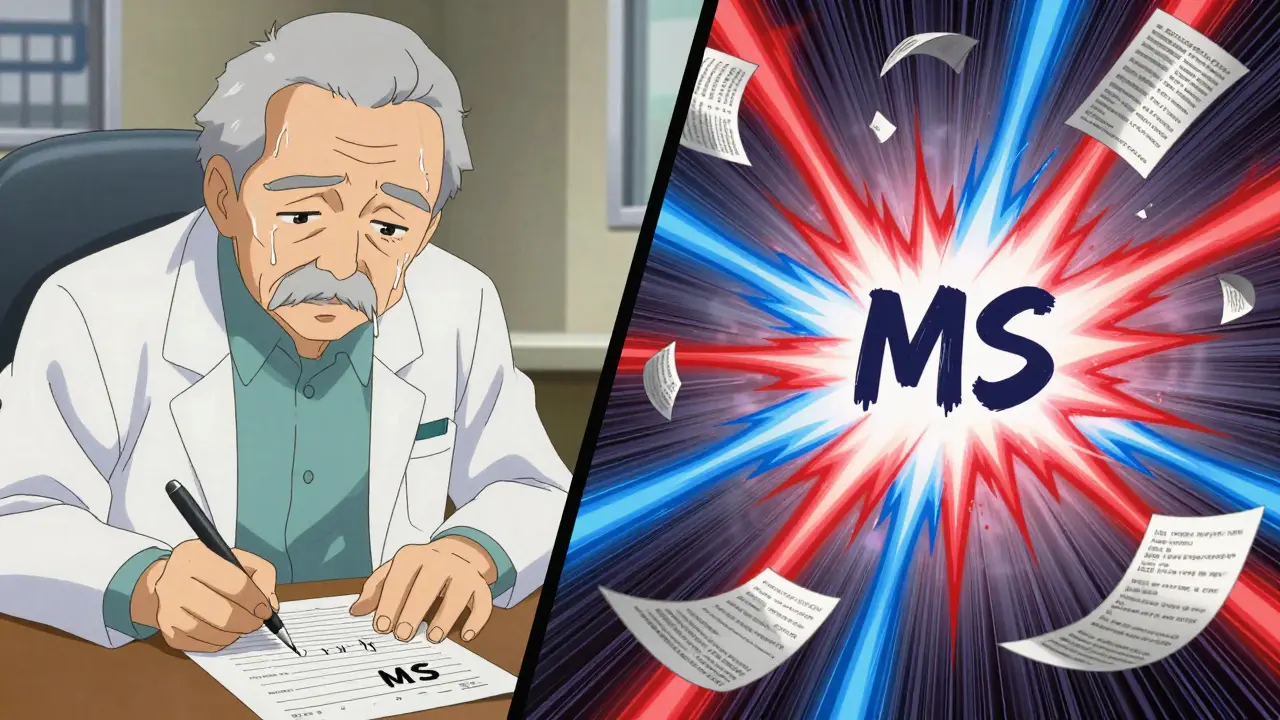
Why Do People Still Use Them?
You’d think after 20+ years of warnings, everyone would stop. But they don’t. A 2022 survey by the American Medical Association found that 43.7% of physicians over 50 still use banned abbreviations. Why? Habit. Tradition. “I’ve always written it that way.” It’s not just old doctors. In fast-paced clinics, time pressure leads to shortcuts. A busy nurse scribbles “TAC” for triamcinolone cream. But “TAC” also looks like “Tazorac,” a different skin drug. The patient gets the wrong treatment. The error isn’t caught until days later. Even with electronic health records (EHRs), the problem persists. EHRs cut abbreviation errors by 68%, but 12.7% of errors still happen - because someone types a free-text note. Or clicks the wrong dropdown. Or uses a custom template that includes “QD.”How Hospitals Are Fixing This
The good news? We know how to fix it. Mayo Clinic implemented a full program in 2020: EHR hard stops, mandatory training, real-time alerts, and penalties for repeat offenders. Within 18 months, abbreviation-related errors dropped by 92.3%. The key ingredients?- EHR hard stops - The system won’t let you submit “QD.” It forces you to type “once daily.”
- Training for everyone - Not just doctors. Nurses, pharmacists, coders - everyone who touches a prescription.
- Feedback loops - When someone uses a banned abbreviation, they get an alert: “Please use ‘once daily’ instead.”
- Leadership enforcement - No exceptions. Even senior doctors get flagged.
What You Can Do - Whether You’re a Doctor, Pharmacist, or Patient
This isn’t just a hospital problem. It’s everyone’s problem.- If you’re a prescriber: Never use abbreviations. Type out “once daily,” “milliliters,” “unit,” “morphine sulfate.” It takes two extra seconds. It could save a life.
- If you’re a pharmacist: Always double-check. If you see “MS,” call the prescriber. Don’t assume. Ask. If you see “U,” confirm it’s not “10.”
- If you’re a patient: Always ask: “What is this medicine for? How often do I take it?” If you see “QD” or “U” on your prescription, say: “Can you write that out in full?”

Let me tell you something - this whole ‘write it out’ thing is just government overreach disguised as safety. I’ve been a nurse for 32 years and I’ve never lost a patient to a QD. You think hospitals are dangerous? Try getting a prescription filled in Canada without them asking if you’re ‘on opioids’ while you’re buying ibuprofen. This is panic dressed as protocol. They’re turning medicine into a compliance circus.
Thank you for this. 🙏 I work in a rural pharmacy and I’ve had to call doctors 3 times this week just to clarify ‘U’ vs ‘10’ or ‘MS’ - once for a 7-year-old with asthma. It’s not just about rules, it’s about love. Writing it out takes 5 seconds. Not writing it out could take a life. Please, please, please - be the person who chooses clarity. 💙
bro i just typed ms for morphine and my ehr auto-corrected it to ‘magnesium’ and i was like 😳 wait what? then i realized i was using a template from med school 2012 and my boss yelled at me. i’m 32. i know better. but man, the system is broken. also lol why is everyone so scared of a little ‘u’? it’s not like we’re writing ‘cc’ for cocaine 😅
It is imperative to emphasize that the persistent usage of ambiguous medical abbreviations constitutes a grave breach of patient safety standards, as formally documented by The Joint Commission and the Institute for Safe Medication Practices. The statistical prevalence of errors associated with QD, U, and MS is not merely anecdotal; it is empirically validated through peer-reviewed studies conducted across North American healthcare systems. Therefore, adherence to full terminology is not a recommendation-it is a non-negotiable ethical obligation.
Ok but who REALLY benefits from this? I’ve seen the same hospital get fined for ‘MS’ but then give out 500mg of Tylenol to a toddler because the EHR dropdown said ‘acetaminophen’ and the nurse clicked ‘adult dose’. This isn’t about safety-it’s about liability. They don’t want you to make mistakes. They want you to be so scared you never write anything. And now they’re using AI to spy on your typing. I’ve seen the internal memos. They’re tracking keystrokes. 🤫
As a pharmacist, I can confirm: QD is the #1 error. I once had a patient come in because they were vomiting after taking ‘QD’ insulin. Turns out, the doctor meant ‘once daily’ but the EHR auto-filled it as ‘QID’ because of a legacy template. We caught it because the patient had a history of diabetes and we double-checked the dose. But not everyone has that context. Always spell it out. It’s not hard. And it saves lives.
you guys are doing amazing work. i know it’s frustrating when you’re rushed, but i’ve seen what happens when we skip the extra second. my dad almost died because of a ‘U’ mistake. please don’t give up. even if it feels like no one listens, you’re changing things. i’m proud of you. 💪
Let’s be real - this is all a distraction. The real killer in hospitals is understaffing and corporate greed. They’re forcing nurses to see 12 patients an hour while pushing ‘safety protocols’ like this to look good on audits. You think they care about ‘once daily’? No. They care about avoiding lawsuits. They’ll let you write ‘QD’ if it means they don’t have to hire another nurse. This is performative safety. Wake up.
Clarity isn’t the last line of defense - it’s the illusion of control. We pretend that spelling out ‘unit’ will prevent death but we ignore the fact that humans are flawed, systems are chaotic, and power structures decide who lives and who dies. You think a doctor writing ‘MS’ is the problem? No. The problem is a system that demands perfection from people who are exhausted, underpaid, and overworked. This isn’t about abbreviations. It’s about the moral bankruptcy of modern medicine. And you? You’re just polishing the coffin.