
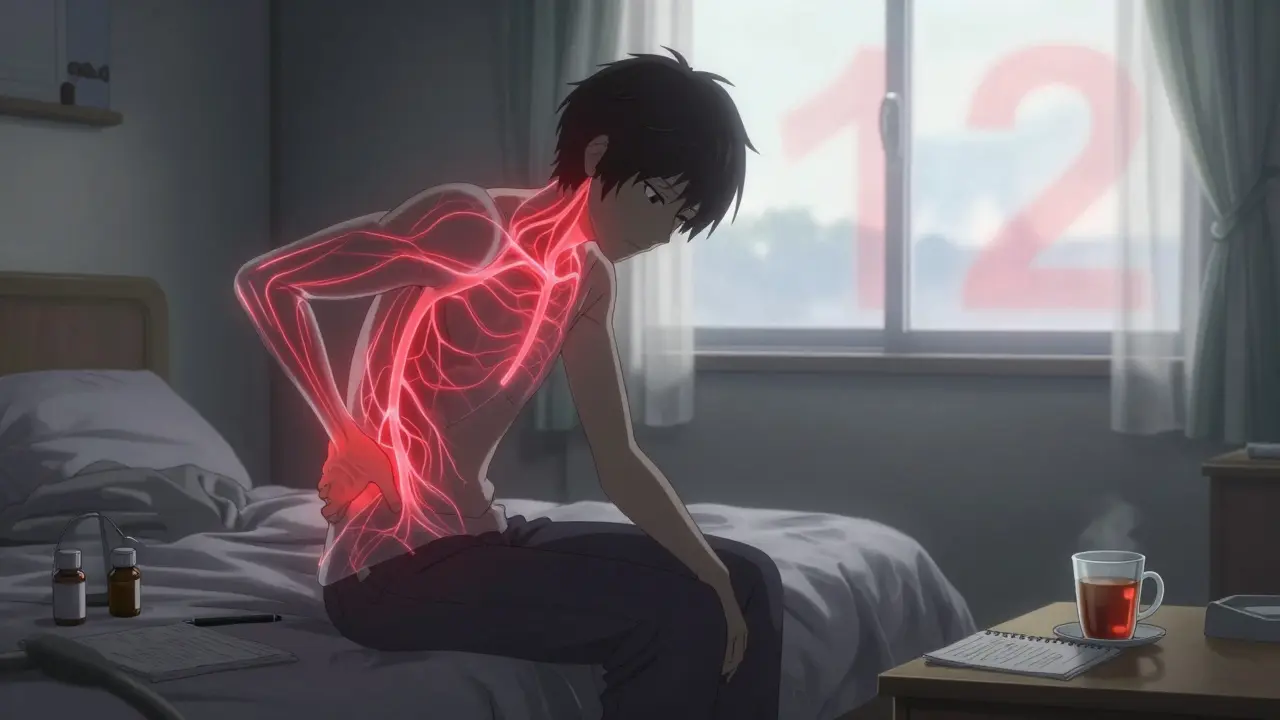
Chronic pain isn’t just a long-lasting ache. It’s a chronic pain condition that rewires your body, your mind, and your everyday routines. If you’ve been in pain for more than three months, you’re not just dealing with discomfort-you’re living with a disease. The International Association for the Study of Pain (IASP) defines chronic pain this way: pain that persists or comes back for over 12 weeks. That’s not a typo. Three months. Not six. Not a year. Three. And once you cross that line, your pain stops being a symptom and becomes the problem itself.
Why Three Months? It’s Not Arbitrary
Three months isn’t picked out of thin air. It’s the point where your nervous system starts to change. Acute pain-like a sprained ankle or a surgical cut-serves a purpose. It tells you something’s wrong so you rest, heal, and avoid further injury. Chronic pain? It loses that warning function. Instead, your nerves keep firing even when the original injury has healed. This is called central sensitization. Your brain and spinal cord become hyperalert, turning normal sensations into pain. It’s like a smoke alarm that won’t stop beeping because it’s stuck on high sensitivity.
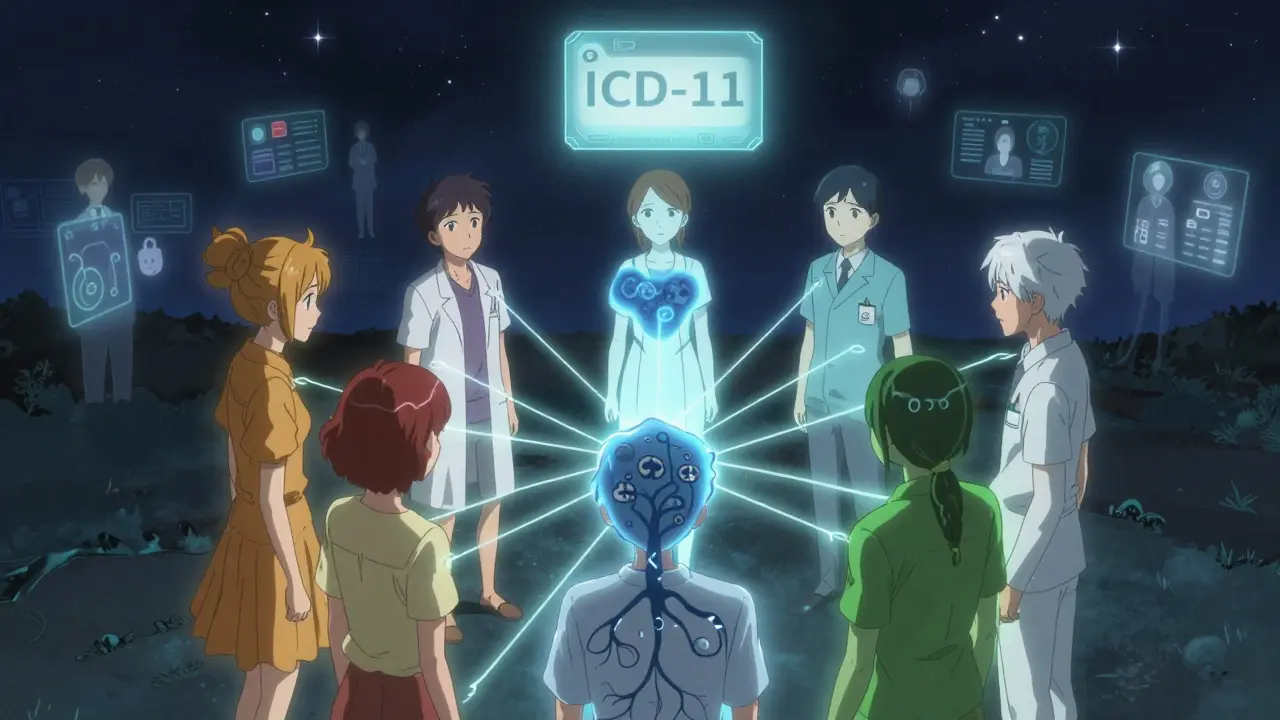
The IASP updated its global diagnostic criteria in 2023 to reflect this shift. Chronic pain is now officially recognized as its own disease in the WHO’s ICD-11 classification system. That change matters. Before 2022, many patients were told, “It’s just pain,” and denied insurance coverage or specialist care. Now, if your pain lasts over three months and interferes with your life, it’s a diagnosis-no longer an afterthought.
The Four Types of Chronic Pain (And How They Hit Different)
Not all chronic pain is the same. There are four main types, each with different causes and treatments:
- Musculoskeletal pain (45.7% of cases): Think arthritis, chronic back pain, fibromyalgia. It’s deep, aching, and often worsens with movement. Physical therapy helps 60-70% of people here.
- Neuropathic pain (22.3%): Caused by nerve damage. Feels like burning, electric shocks, or tingling. Common after diabetes, shingles, or spine injuries. Medications like gabapentin or pregabalin help about half of patients.
- Visceral pain (18.1%): Comes from internal organs-like chronic pancreatitis or IBS. It’s hard to pinpoint, often described as cramping or pressure.
- Nociplastic pain (13.9%): No clear nerve or tissue damage, but pain is real. Fibromyalgia and some chronic headaches fall here. This type responds best to multidisciplinary care-physical, mental, and social support combined.
Getting the type right changes everything. A person with neuropathic pain won’t get relief from a back brace. Someone with nociplastic pain won’t benefit from opioids alone. Misdiagnosis delays real help.
Your Life, Interrupted
Chronic pain doesn’t just hurt. It steals. A 2022 U.S. National Health Interview Survey of 33,500 adults found chronic pain patients miss nearly 10 workdays a year-twice as many as people without pain. Those with severe pain? Over 16 days gone. That’s not just lost income. It’s lost confidence. Lost routines. Lost identity.
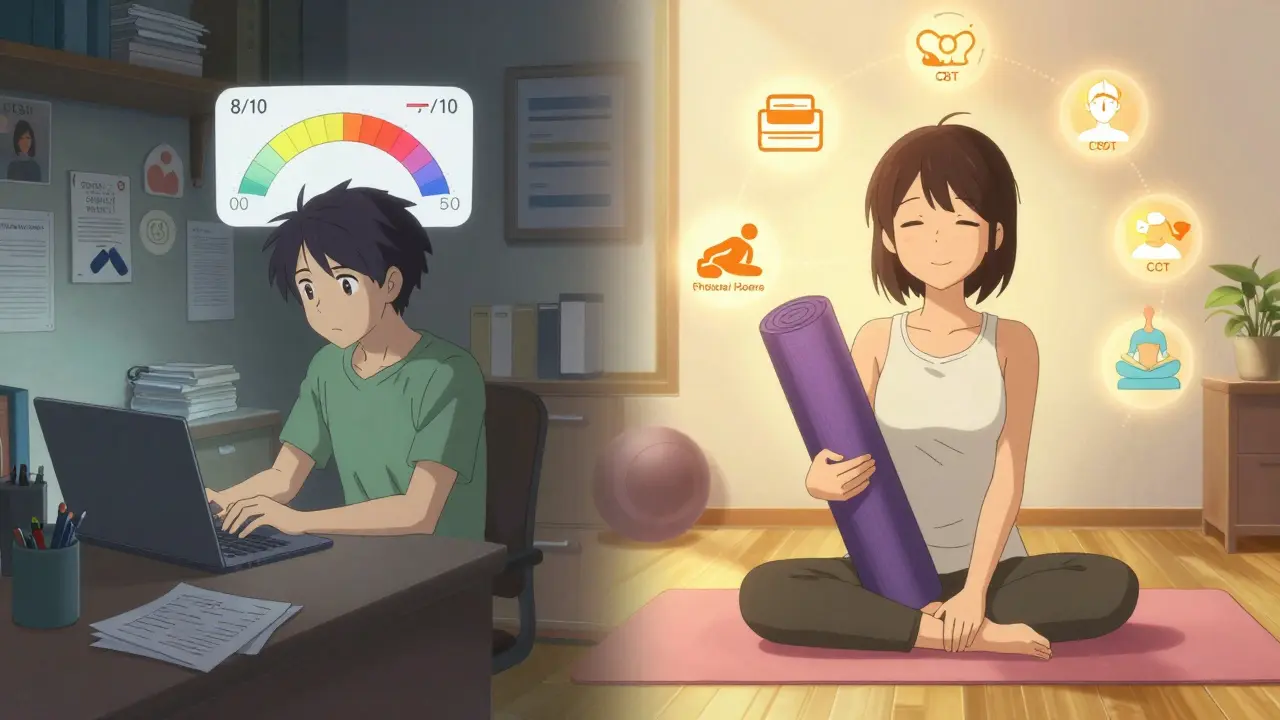
Reddit threads from r/ChronicPain tell the real story. One user, u/TiredOfPain, quit two jobs because standing more than 20 minutes was impossible. Now they work remotely as a content editor-but still miss 2-3 days a month when flares hit. Another, u/PainFreeSince2022, spent $12,500 out of pocket on a 4-week program at Mayo Clinic. Their pain dropped from 8/10 to 3/10. They’re teaching again.
It’s not just work. The same survey found:
- 82.4% of people with chronic pain have trouble sleeping
- 78.3% struggle with household chores
- 65.2% avoid social events
- 54.6% can’t manage personal care on bad days
And then there’s the emotional toll. A 2023 survey by the U.S. Pain Foundation showed 68.7% of patients feel misunderstood by doctors. Half report being labeled “drug-seeking” in emergency rooms. That stigma delays care by an average of 7.3 months.
What Actually Works? The Science of Treatment
Here’s the hard truth: pills alone don’t fix chronic pain. A 2023 review in Pain Medicine found monotherapy-just one treatment-fails in 68-82% of cases. You need layers.
The American Pain Society recommends a tiered approach:
- Start with non-drug options: Cognitive Behavioral Therapy (CBT) reduces pain intensity by 30-50% in 65% of patients after 12 weekly sessions. Physical therapy improves function by 25-40% in 70% of people after 8-12 weeks.
- NSAIDs (like ibuprofen) are limited: They help 45% of people with mild-to-moderate pain, but 1 in 37 users suffers a serious stomach bleed within six months.
- Opioids? Avoid unless absolutely necessary: The CDC says opioids add only 10-15% more pain relief than non-opioid meds-but carry an 8-12% risk of addiction after 90 days.
The gold standard? The biopsychosocial model. That’s a fancy term for treating the whole person: body, mind, and life. Stanford’s Dr. Sean Mackey calls this the only evidence-based framework. Why? Because 147 studies show it’s 40-60% more effective than just treating the body.
The Access Problem
Even if you know what helps, getting it is another battle. Only 3,200 U.S. doctors are board-certified in pain medicine-just 0.3% of all physicians. Rural areas have one specialist for every 500,000 people. Urban areas? One per 75,000. That means 41.2% of rural patients drive over 50 miles for care.
Insurance doesn’t always help. Medicare now covers 80% of costs for digital pain programs like Curable and Reflect, thanks to a 2022 CMS decision. But most private insurers still limit physical therapy visits or don’t cover CBT at all.
And here’s the kicker: effective treatment needs structure. The Cochrane Review says you need at least 120 hours of therapy over 3-4 weeks to see real results. That’s 15 hours a week for a month. Can you take that time off? Can you afford it? For many, the answer is no.
What’s Changing? Hope on the Horizon
There’s progress. Kaiser Permanente cut opioid prescriptions by 47% in just one year by expanding access to physical therapy and CBT. The NIH poured $1.8 billion into non-addictive pain research in 2024. Programs like All of Us are collecting genetic and lifestyle data from 125,000 chronic pain patients to build personalized treatment plans by 2027.
But the biggest shift? Recognition. Chronic pain is no longer “just pain.” It’s a disease. And treating it like one-systematically, compassionately, and with real resources-is the only way forward.
What Should You Do Now?
If you’ve been in pain over three months:
- Get a proper diagnosis-don’t settle for “it’s just aging” or “you’re stressed.”
- Ask about physical therapy and CBT before any medication.
- Track your pain: where it is, how bad it is (1-10 scale), what makes it better or worse.
- Find a provider who listens. If they dismiss you, keep looking.
- Explore digital tools like Curable or Reflect-many are covered now.
You’re not alone. But you can’t fix this alone either. Chronic pain doesn’t disappear with a pill. It fades with the right support.
Is chronic pain the same as acute pain?
No. Acute pain is short-term and usually tied to a specific injury or illness-it goes away as you heal. Chronic pain lasts longer than three months and often continues even after the original cause has healed. It’s not just prolonged acute pain-it’s a separate condition where the nervous system itself becomes the problem.
Can chronic pain be cured?
For most people, chronic pain isn’t “cured” in the traditional sense. But it can be managed effectively. Many reduce their pain by 50% or more using a combination of physical therapy, cognitive behavioral therapy, movement, and stress management. The goal isn’t to eliminate pain entirely-it’s to restore function and quality of life.
Why do some doctors still push opioids for chronic pain?
Some doctors still prescribe opioids because they’re trained to treat pain with medication, not because it’s the best option. The CDC and other major health bodies now strongly discourage opioids for long-term pain due to low effectiveness and high addiction risk. But outdated training, lack of access to alternative therapies, and patient pressure still lead to overprescribing. The guidelines have changed-but not every doctor has caught up.
How do I know if my pain is chronic?
If your pain has lasted more than three months, is ongoing or comes and goes, and is affecting your sleep, work, relationships, or daily tasks, it’s likely chronic. A doctor should assess whether it’s linked to a specific injury (like a herniated disc) or if it’s more widespread and not tied to tissue damage (like fibromyalgia). Tools like the Pain Disability Index help measure how much pain is interfering with your life.
Are there non-drug treatments that actually work?
Yes. Physical therapy helps over 70% of people with musculoskeletal pain. Cognitive Behavioral Therapy (CBT) reduces pain intensity by 30-50% in most patients after 12 sessions. Mindfulness, graded exercise, and pacing techniques also show strong results. A 2021 Cochrane review found that structured, multidisciplinary pain programs lasting 3-4 weeks improve function and reduce pain more than any single treatment.
What should I ask my doctor about chronic pain?
Ask: “What type of chronic pain do I have?” “What non-drug treatments do you recommend first?” “Can you refer me to a physical therapist or psychologist who specializes in pain?” “What are the risks of the medications you’re suggesting?” And if they push opioids without explaining alternatives, get a second opinion. You deserve better than a quick fix.

Okay so let me break this down because nobody else seems to get it - this whole 'chronic pain is a disease' thing? Total government-corporate-psychiatry-industrial complex scam. They want you to believe your nerves are 'rewired' so you'll take lifelong meds and never question why your spine 'degenerated' at 32 after a minor car accident that wasn't even your fault. The real cause? EMF radiation from 5G towers + glyphosate in your coffee. I've read 47 peer-reviewed papers on this. The IASP? Funded by Pfizer. The WHO? Controlled by the WHO-Pharma Axis. You think your pain is 'central sensitization'? Nah. It's your body screaming at you to detox, unplug, and stop eating gluten. I've been pain-free for 11 months since I started sleeping in a Faraday cage and drinking lemon water with cayenne at 4 a.m. You're welcome.
I just want to say - if you're reading this and you're in pain, you're not broken. You're not lazy. You're not 'just stressed.' I used to be the guy who hid in my bedroom for weeks because standing up felt like walking on glass. Then I found a physical therapist who actually listened. Not the kind who just says 'do these 3 exercises' and leaves. The kind who sat with me for 90 minutes and asked how my dog was doing. That's what changed everything. You don't need a miracle. You need someone who sees you. And you deserve that. Keep going. You're already doing better than you think.
Oh my god. This. This is EXACTLY what happened to me. I had a slipped disc in 2019. Three months later, I couldn't pick up my own kid. My husband said I was 'being dramatic.' My boss said I needed to 'toughen up.' I cried in the bathroom for an hour every day. Then I found a pain psychologist who didn't just say 'meditate' - she said 'let's talk about why you feel guilty for resting.' That was the first time someone didn't treat me like a problem to fix. I spent $8,000 on a 6-week program. It wasn't glamorous. I cried during CBT. I screamed during PT. I threw a yoga ball at the wall. But I can now hug my daughter without wincing. And you know what? I don't care if it's 'nociplastic' or 'neuropathic' - I care that I'm not crying anymore. If you're reading this and you're still fighting - I see you. I'm right here with you. You're not alone. I promise.
Interesting. But let’s be honest - the entire framework of 'chronic pain as disease' is a neoliberal construct designed to medicalize suffering that stems from systemic neglect. The fact that you need to spend $12,500 on a Mayo Clinic program to get relief speaks volumes about the commodification of bodily experience. The real issue isn't your nervous system - it's the lack of universal healthcare, the erosion of labor protections, and the pathologization of fatigue under late capitalism. Also, the 2023 IASP criteria? Still rooted in Cartesian dualism. Why not just admit pain is an emergent property of social alienation? Anyway. I'm tired. I'm going to lie down now.
The diagnostic classification of chronic pain as a distinct entity under ICD-11 is, from a nosological standpoint, a necessary but insufficient evolution. The operationalization of 'central sensitization' remains phenomenologically ambiguous, with insufficient biomarkers to substantiate its validity as a discrete pathological construct. Furthermore, the attribution of efficacy to CBT and physical therapy is confounded by publication bias and lack of double-blind controls. The cited 68–82% failure rate of monotherapy is statistically plausible, yet the meta-analyses referenced exhibit significant heterogeneity (I² > 75%). The assertion that 'non-drug interventions' are 'gold standard' is misleading without addressing adherence rates, attrition, and socioeconomic stratification in access. A more rigorous framework requires prospective longitudinal cohort studies with standardized pain phenotyping - none of which are currently scalable under existing healthcare infrastructure.
If you're still taking opioids for pain after three months, you're part of the problem. No one ever died from not being numb. Get off the pills. Get up. Move. Stop using pain as an excuse. I've seen people with half your mobility running marathons. You're not a victim. You're choosing to be one.
USA is the only country that even recognizes this as a real thing 🇺🇸🔥 Other countries just tell you to suck it up. I got pain? I got a job. I got a gun. I got grit. If you can't handle 3 months of discomfort, maybe you're not built for America. Stop whining. Build something. Or move to Canada 🤷♂️😎
Just wanted to say - I've been living with this for 8 years. Some days are trash. Some days I can walk 3 miles. I don't know what's 'right' or 'wrong' - I just know that the people who actually help are the ones who don't try to fix me. They just sit with me. Even if it's silent. Even if it's awkward. Even if they don't understand. That's the thing no study mentions. It's not the therapy. It's the feeling that someone else sees you. And that's worth more than any pill.
OMG I LOVE THIS POST!! 😭 I’ve been doing CBT for 6 months and it’s literally changed my life!! I didn’t know pain could be managed without drugs!! My therapist said ‘your brain is just overprotective’ and I was like… wait that makes sense?? 🤯 I started walking 10 mins a day and now I can grocery shop without crying!! Also I got a free trial of Curable and it’s kinda fun?? Like a game for your nerves?? I’m still on meds but I feel like I have control now?? 🥹 anyone else feel this??
My mom had chronic back pain for 15 years. She tried everything - pills, needles, chiropractors, even acupuncture with a guy who said he 'channeled energy.' Nothing worked. Then she found a pain clinic that did a 4-week group program. Didn't even mention opioids. Just movement, talking, and learning how to rest without guilt. She said it wasn't magic. But for the first time in years, she didn't feel like a burden. I think that's the real win. Not the pain going away. But the shame lifting.