
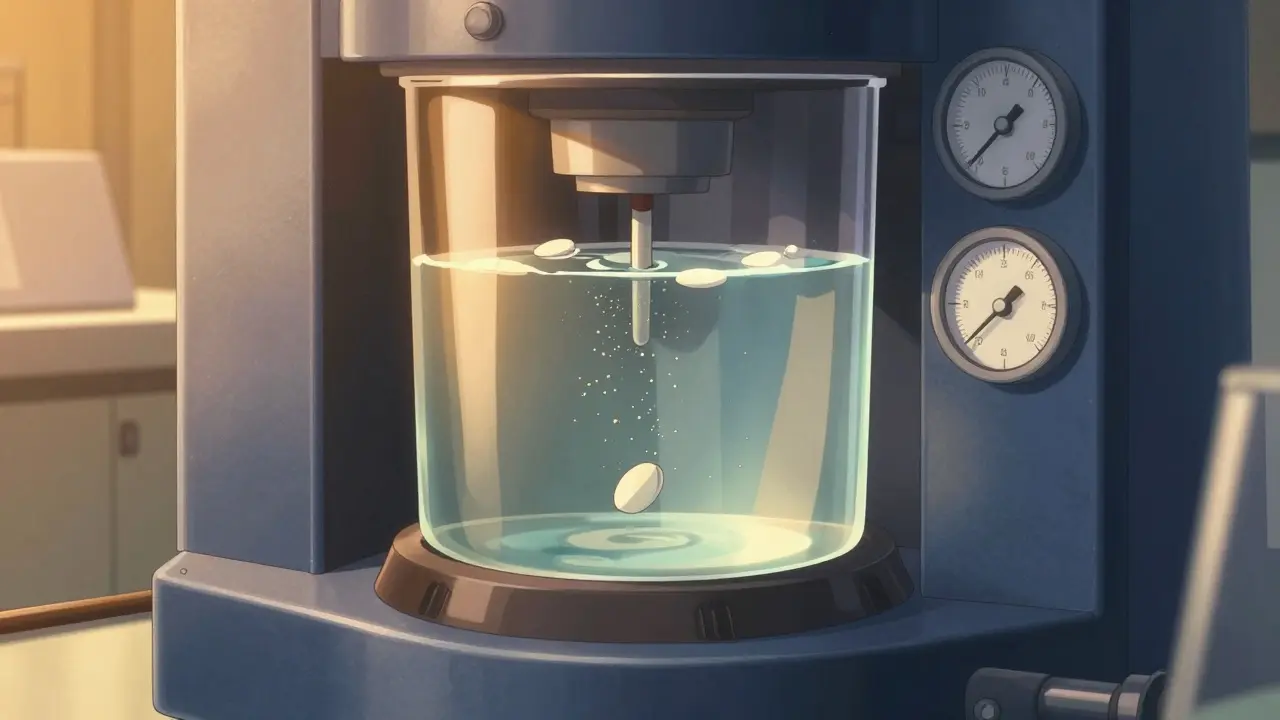
Imagine swallowing a generic pill for your heart medication. You expect it to work exactly like the expensive brand-name version, but do you know what proves it works the same way inside your body? It isn't magic-it's Dissolution Testinga critical laboratory procedure that measures how quickly and completely a drug releases its active ingredients in liquid. This process serves as the primary scientific gatekeeper between a potential generic product and the pharmacy shelf. While human trials provide definitive proof of safety and efficacy, regulators rely on this *in vitro* (outside the body) analysis as a cost-effective, ethical proxy to ensure therapeutic equivalence.
The Science Behind the Pill Breakdown
When you pop a tablet, it doesn't vanish instantly. It has to disintegrate and dissolve so your stomach and intestines can absorb the medicine. This rate of release dictates how fast the drug enters your bloodstream and starts working. If a generic tablet dissolves too slowly, it won't help you when you need it. If it dissolves too fast, you might get an overdose spike. The U.S. Food and Drug Administration (FDA) mandates strict controls over this process to guarantee that Generic Drugsmedications containing the same active ingredient as a previously approved brand-name drug perform identically to the reference standard.
Testing happens before approval. Manufacturers cannot simply claim their factory makes better pills; they must prove mathematically that the chemical profile matches the original reference listed drug (RLD). This evidence forms a massive part of the Abbreviated New Drug Application (ANDA) submission package. It essentially tells the regulator: "We don't need to test thousands of humans because our lab machines show the chemistry is identical." For most immediate-release solid oral dosage forms, this means meeting the famous "80% in 30 minutes" benchmark, though the specific clock varies by drug type.
FDA Requirements for Submission Data
Regulatory bodies do not accept vague assurances. According to updated guidance documents, specifically those released in late 2023, agencies require manufacturers to submit five specific categories of data. First, they must characterize the solubility of the bulk drug substance. Is it naturally easy to dissolve, or stubborn? Second, they must validate the testing conditions themselves-proving that the temperature, buffer pH, and rotation speed of the machine are correct.
Third, robustness verification ensures the test holds up even if slight variations occur during routine manufacturing. Fourth, the analytical method used to measure the dissolved drug must be proven accurate. Finally, and perhaps most critically, the test must demonstrate discriminatory power. A good test should fail a bad batch. If a manufacturer accidentally produces a pill that shouldn't pass, the dissolution test must detect it immediately. This prevents substandard products from reaching patients under the guise of quality control.
Comparing Test and Reference Products
How do regulators decide if two tablets are truly similar enough? They don't just look at single numbers. They compare the entire curve of how the drug releases over time. To do this, pharmacists use a calculation known as the f2 similarity factor. On a scale from zero to 100, a score of 50 or higher indicates statistical similarity between the generic candidate and the reference product. Think of it like fingerprint matching-the curves don't need to be identical, but the pattern must match closely enough to predict the same behavior in a living patient.
This mathematical comparison becomes vital when there is no official published test in the United States PharmacopeiaUSPthe official compendium of drug quality standards in the United States for that specific medicine. In these "Category 2" scenarios, the generic maker must run their own side-by-side experiments against the branded RLD under multiple conditions. This flexibility allows innovation while maintaining the strict barrier against ineffective formulations.
| Criteria | Immediate Release Standard | Modified Release Standard |
|---|---|---|
| Solvent Volume | 900 mL typically | Varies by release target |
| Timeframe | 30 to 45 minutes | Up to 24 hours |
| pH Conditions | Single condition (usually 0.1N HCl) | Multistage (pH 1.2 to 6.8) |
| Pass Limit | 80% released | Percentage per time point |
Navigating Complex Formulations
Not all pills are simple sugar cubes. Some medications use special coatings to release medicine slowly over a day. These modified-release formulations require much more scrutiny. For these drugs, scientists must evaluate performance across multiple pH levels, simulating the journey from the stomach to the intestine. There is also a risk assessment for "dose dumping," where mixing the medication with alcohol causes the whole dose to crash out at once. Regulators test these interactions to prevent dangerous spikes in blood concentration.
The complexity scales with the difficulty of dissolving the active pharmaceutical ingredient itself. Highly soluble drugs falling under the Biopharmaceutical Classification Systema framework categorizing drugs based on solubility and intestinal permeability Class I criteria often get a shortcut called a biowaiver. Since they dissolve so well anyway, the regulator might waive the need for human studies entirely if the lab tests look good. Conversely, low-solubility drugs demand complex multi-stage testing protocols to prove they behave consistently.
The Role of Manufacturing Changes
Even after a drug hits the market, manufacturers might want to move factories or tweak the recipe slightly. The FDA tracks this through the Scale-Up and Post-Approval Changes (SUPAC) framework. Any change to the site, equipment, or ingredients triggers a requirement to re-run dissolution profiles. If the new profile differs significantly from the old one, the company has to explain why the patient won't notice a difference. This continuous monitoring ensures that the quality established during approval remains intact years later.
Manufacturers maintain access to a public resource known as the Dissolution Methods Database. Maintained by the Division of Bioequivalence, this tool provides specific recommendations for thousands of drug products. As of late 2023, it contained guidance for over 2,800 unique formulations. Relying on these standardized methods speeds up approvals because both the applicant and the reviewer speak the same technical language regarding acceptable parameters.

Future Directions and Global Standards
The technology continues to evolve toward mimicking actual physiology more closely. Future methodologies aim to better simulate the gastrointestinal environment, potentially reducing reliance on traditional single-point tests. Experts in pharmaceutical quality suggest that by the mid-2020s, more approvals will leverage physiologically relevant methods to predict *in vivo* performance. This shift helps balance efficiency with absolute patient safety, ensuring that the convenience of generics never comes at the cost of reliability.
Frequently Asked Questions
Why is dissolution testing preferred over human studies?
It acts as a surrogate for clinical trials, saving significant costs and time. By proving the drug dissolves identically to the brand name in a lab, regulators can bypass extensive human trials that would be ethically unnecessary for equivalent drugs.
What happens if a generic fails the 80% limit?
If a formulation fails to meet the acceptance criteria within the specified timeframe (often 45 minutes), it usually signals poor quality. The manufacturer must reformulate the drug before resubmitting the application for approval.
Does the FDA test every batch of generic drugs?
No, the FDA does not test every single batch released to pharmacies. However, manufacturers are legally required to perform this testing on every batch produced as part of Good Manufacturing Practices before shipping them.
What is the f2 similarity factor?
It is a mathematical calculation comparing the dissolution profile of the generic drug against the reference drug. An f2 value of 50 or higher on a 0-100 scale suggests the two profiles are statistically similar.
Can dissolution tests replace bioavailability studies?
Yes, for certain classes like BCS Class I drugs (high solubility, high permeability). In these cases, passing the dissolution test earns a "biowaiver," meaning no human study is required for approval.