

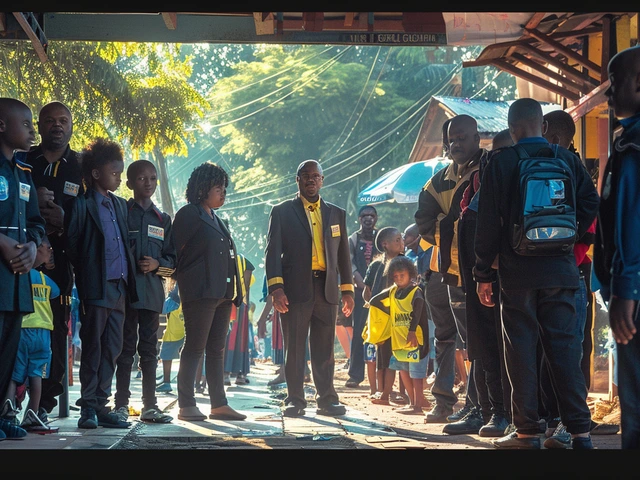
On a momentous day of March 22, 2024, the streets of Franceville, a city known not only for its picturesque landscapes but now for its healthcare milestones, witnessed the initiation of a groundbreaking campaign. This campaign, led by Gabon's Ministry of Health and backed by international health organizations such as the World Health Organization (WHO), marks a definitive step towards eradicating child worm infestations and bilharzia within its borders. The location for this landmark launch was Collège d’Enseignement Secondaire Mamadou Lewo, chosen strategically within the fourth district of Haut-Ogooué province, symbolizing a beacon of hope for the children of Gabon.
Worm infestations and bilharzia, also known as schistosomiasis, have long plagued the developing world, causing a silent crisis that impacts millions of children, hindering their growth, health, and educational opportunities. Gabon's bold initiative aims to confront this crisis head-on by distributing crucial worm treatment drugs, specifically Mebendazole and Praziquantel tablets, to children between the ages of five to fourteen across the nation. The campaign's immediate focus is on the Haut-Ogooué region, where for a two-week period, children will receive these life-altering treatments.
This remarkable endeavor is framed by a clearly defined goal: to significantly reduce the incidence of worm infestations and bilharzia among school-aged children, thereby unlocking a brighter future where the potential of Gabon's younger generation can be fully realized. Key to this initiative is the personalized approach to treatment, with dosages carefully determined by each child's size and weight, ensuring not only effectiveness but also safety.
According to Iris Kevin Ivala Zogo, the Director of Regional Health South East, the campaign has set its sights on a challenging but achievable target - treating 73,001 children within the region. This figure is not just a number but represents a significant portion of Gabon's future, each child benefiting from the campaign bringing the nation one step closer to eradicating these debilitating diseases.
The support from the WHO not only underscores the global significance of this health campaign but also enhances its credibility and logistical capability. Such partnerships are pivotal in addressing healthcare challenges, with international collaboration bringing forth the strength and expertise needed to combat complex health issues like worm infestations and bilharzia.
As the campaign unfolds, the eyes of the world will be on Franceville and Gabon, watching closely as this ambitious project moves forward. Success here could serve as a model for other nations grappling with similar health crises, demonstrating that with determination, collaboration, and targeted action, it is possible to make significant strides in public health. This initiative reflects a broader commitment to enhancing the wellbeing of all citizens, recognizing that the health of children is a vital component of societal progress and prosperity.
Looks like they finally realized that worm meds are cheaper than treating an entire generation of sick kids.
Ah, the noble quest to scrub parasites from the soil of Africa – how uplifting.
One could argue the real miracle is persuading bureaucrats to fund something that a single dose can solve.
Yet here we are, watching a health ministry perform what should be common sense on a grand stage.
Imagine the philosophical depth of a nation deciding to invest in its kids’ intestines over endless political drama.
And of course, we’ll all cheer while the WHO gets a gold star for “sponsoring another poster child.”
The scale of treating over 70,000 children is impressive, especially when each dose is tailored to weight.
Targeted deworming can dramatically improve school attendance and learning outcomes.
Having WHO involved also means the logistics and drug quality are likely up to international standards.
It’ll be interesting to see post‑campaign data on infection rates in Haut‑Ogooué.
That’s the kind of community effort that really lifts spirits – kids get healthier, parents feel relief, teachers see more focused classrooms.
It’s a reminder that public health wins are built on small, coordinated steps.
Hope the follow‑up support keeps the momentum going beyond the initial two weeks.
One can’t help but wonder if there’s a hidden agenda behind the WHO’s shiny badge.
Are we sure the medication isn’t a front for some larger surveillance program?
It’s odd how quickly they mobilize resources when a public health narrative aligns with their global branding.
Still, if the pills work, perhaps the conspiracy is just a side dish to the main course of disease eradication.
From an inclusive mentorship standpoint, this campaign is a textbook example of how coordinated health initiatives can empower entire communities.
First, the decision to focus on school‑aged children directly addresses a demographic that is both vulnerable and pivotal for future societal development.
Second, the collaboration with international bodies like the WHO ensures a level of expertise and resource allocation that would be difficult for a single nation to muster alone.
Third, the emphasis on dosage based on individual weight demonstrates a respect for safety and efficacy that is commendable.
Moreover, by targeting the Haut‑Ogooué region first, the program creates a scalable model that can be adapted to other districts with varying epidemiological profiles.
It is also noteworthy that the campaign’s communication strategy includes public education, which is essential for sustaining long‑term behavioral change.
When children understand why they are taking medication, they become ambassadors of health within their families.
In addition, the logistical coordination required to treat 73,001 children is a massive undertaking that showcases effective governance and planning.
Such an operation inevitably involves training local health workers, which builds capacity that will outlast the immediate campaign.
While the short‑term goal is to reduce worm and bilharzia prevalence, the long‑term ripple effects could include better school performance, reduced healthcare costs, and stronger community resilience.
There is also a subtle but powerful narrative of hope that emerges when a government visibly invests in the health of its youngest citizens.
If successful, this initiative could serve as a benchmark for other nations grappling with similar parasitic burdens, illustrating that with determination, collaboration, and proper resource allocation, significant public‑health milestones are achievable.
Thus, beyond the immediate medical impact, the campaign may catalyze a broader cultural shift toward proactive health management.
In summary, this effort blends scientific rigor, community engagement, and strategic planning, making it a compelling case study for global health practitioners.